
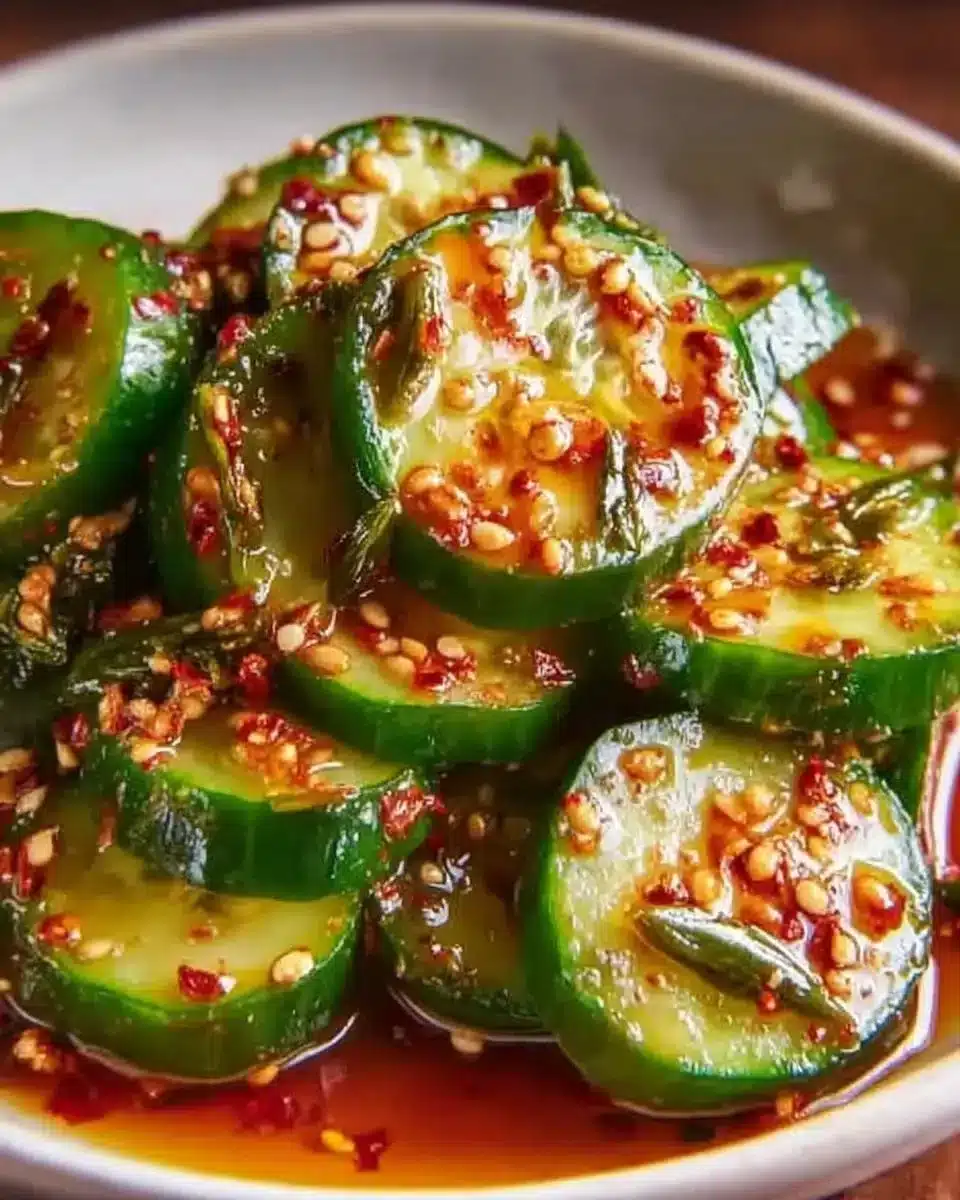
Korean Cucumber Salad (Oi Muchim)
Bright, crunchy, and just a little spicy — this Korean Cucumber Salad wakes up the plate with bright vinegar, sesame oil, and chile flakes. Korean Cucumber Salad is fast to make and keeps its crisp snap for hours, so it’s perfect for quick weeknight meals or large gatherings. I developed this version after testing it eight times with different cucumbers and salt levels, and I refined the dressing during my years cooking Korean food professionally. The result balances heat, tang, and texture so the cucumbers stay crunchy and the flavor is bold but clean. Read on for the ingredient science, exact measurements in metric and imperial, step-by-step photos, and storage tips so this becomes your go-to oi muchim. If you like refreshing cucumber recipes, you might also enjoy my twist on a Cucumber Caesar Salad for a creamy contrast to this spicy, vinegary dish.
Why This Recipe Works
- Salt draws moisture from the cucumbers quickly, then a quick squeeze keeps the salad crisp instead of soggy.
- Rice vinegar and a touch of sugar balance the heat from gochugaru (Korean chile flakes), making the flavor bright and layered.
- Toasted sesame oil provides an immediate aroma that tricks the palate into richer flavor with only a small amount of fat.
- Thin slicing and light salting mean you get crunch and bite without long resting times.
- Tested multiple times to hit the sweet spot of salt vs. acid for widely available English cucumbers and Korean cucumbers alike.
Ingredients Breakdown
- Cucumbers — 600 g (about 2 medium English cucumbers) or 800 g (Korean cucumbers if available). Role: main texture and neutral base. Tip: English cucumbers have thinner skins and seeds; Korean cucumbers are crisper and sweeter. If using Persian cucumbers, reduce salt slightly.
- Salt — 1 tsp (6 g) kosher salt, divided. Role: draws out water and seasons. Use Diamond Crystal for lighter volume; if using Morton’s, use half the weight (≈3 g) because it’s denser.
- Rice vinegar — 30 ml (2 tbsp). Role: bright acid that keeps the salad lively. Apple cider vinegar works but adds fruitiness.
- Soy sauce — 15 ml (1 tbsp). Role: umami and salt depth. For low-sodium, use low-sodium soy sauce (you may want to add 1/8 tsp extra salt).
- Sesame oil — 15 ml (1 tbsp), toasted. Role: aroma and a savory finish. Do not substitute with olive oil — the flavor will be noticeably different.
- Gochugaru (Korean chile flakes) — 6 g (1 tbsp) for moderate heat. Role: mild, smoky heat. Substitution: 1 tsp red pepper flakes, but the color and texture differ.
- Sugar — 5 g (1 tsp). Role: balances acid and rounds flavor. Honey is okay; it will thicken the dressing slightly.
- Garlic — 1 clove (3 g), minced. Role: sharp aromatics. If you dislike raw garlic, grate it finely and briefly let it sit in the dressing to mellow.
- Sesame seeds — 1 tsp (2 g), toasted. Role: crunch and nutty finish. Optional but recommended.
- Scallions — 2 stalks (30 g), thinly sliced. Role: fresh oniony bite and color.
Substitutions with impact warnings:
- You can replace soy sauce with tamari for gluten-free; flavor will be slightly deeper.
- If you skip sesame oil, the dish will lack its signature aroma. Use sparingly—a little goes a long way.
Essential Equipment
- Sharp chef’s knife or mandoline — for even, thin slices; if using a mandoline, set to 2–3 mm and use a guard.
- Large mixing bowl — for salting and tossing. A colander can work if you lack a large bowl.
- Salad spinner or heavy paper towels — to remove excess water after salting. A clean towel wrapped around cucumbers and pressed works as a home workaround.
- Measuring spoons and scale (optional but recommended) — for precise salt and oil.
- Small bowl and whisk or jar with lid — to emulsify the dressing.
Step 1: Quick Salt and Drain
Prep time: 15 minutes | Cook time: 0 minutes | Inactive time: None | Total time: 15 minutes | Servings: 4 (about 1/2 cup each)
- Wash and trim 600 g (about 2 medium) cucumbers and slice them thinly into 3–4 mm rounds. If making half-moons, slice lengthwise then crosswise. Use a mandoline for uniform slices, about 2–3 mm thick.
- Toss the cucumbers with 3/4 tsp (4 g) kosher salt in a large bowl. Let stand for 5 minutes until beads of moisture form, then gently press or spin dry. This step draws out excess water quickly and keeps the finished salad crisp.
Step 2: Make the Dressing
- In a small bowl, whisk together 30 ml (2 tbsp) rice vinegar, 15 ml (1 tbsp) soy sauce, 15 ml (1 tbsp) toasted sesame oil, 6 g (1 tbsp) gochugaru, 5 g (1 tsp) sugar, and 1 minced garlic clove (3 g) until the sugar dissolves, about 30 seconds.
- Taste and adjust: if it’s too salty, add 1 tsp (5 ml) water; if too sharp, add another 1/4 tsp (1 g) sugar. This is a small, quick dressing — balance matters.
Step 3: Combine and Finish
- Toss the drained cucumbers with the dressing and remaining 1/4 tsp (2 g) kosher salt, then fold in 2 sliced scallions (30 g) and 1 tsp (2 g) toasted sesame seeds. Toss gently until every slice is coated, about 15–20 seconds.
- Let the salad sit at room temperature for 5–10 minutes for flavors to meld, but serve within 1 hour for maximum crunch. Do not let it sit more than 2 hours at room temperature.
Expert Tips & Pro Techniques
- Use a light hand with salt. Over-salting will draw too much moisture and make the cucumbers limp; under-salting leaves the cucumbers bland. Weigh salt if possible.
- Common mistake and fix: soggy cucumbers come from either too much salt or not draining well. After salting, press slices between paper towels or spin them to remove water before dressing.
- Make-ahead: Mix the dressing up to 3 days ahead and store in a jar in the fridge. Assemble cucumbers just before serving to keep them crisp.
- Professional trick: Toast gochugaru lightly in a dry skillet for 20–30 seconds to deepen color and aroma. Do not burn — toasted chile tastes bitter.
- Knife skill shortcut: If you want ribbons instead of rounds, cut cucumbers lengthwise into thin planks and slice across to make half-moons; they hold dressing better.
- Flavor layering: Add a splash (5 ml / 1 tsp) of mirin for a rounder sweetness if you prefer a smoother finish.
Storage & Reheating
- Refrigerator: Store in an airtight container for up to 3 days. Keep the dressing separate if you want the earliest crunch; toss right before serving.
- Freezer: This salad does not freeze well. Freezing breaks cell walls and turns cucumbers mushy. Do not freeze.
- Reheating: Serve cold or at room temperature. There’s no reheating step; avoid microwaving — it ruins texture and aroma.
Variations & Substitutions
- Mild Version (less heat): Reduce gochugaru to 1/2 tbsp (3 g) and omit garlic. Everything else stays the same.
- Creamy Sesame: Stir 30 g (2 tbsp) tahini into the dressing to add richness; reduce sesame oil to 1 tsp (5 ml). The texture will be creamier and slightly thicker.
- Gluten-Free: Use 15 ml (1 tbsp) tamari in place of soy sauce. No other changes; flavor will be similar.
- Pickled-Style (make-ahead): Increase rice vinegar to 45 ml (3 tbsp) and let the cucumbers sit in the fridge for 2–3 hours. They will soften slightly and taste more tangy — keep for up to 24 hours for best texture.
- Add protein: Toss in 120 g (4 oz) cooked, sliced chicken breast or 160 g (1 cup) cooked shelled edamame for a fuller salad. Keep dressing amounts the same.
In the beet-cucumber-radish combination, the sharpness of radish plays nicely with the sesame — try a version that swaps half the cucumbers for beets: Roasted Beet, Cucumber & Radish Salad.
Serving Suggestions & Pairings
- Classic Korean meal: Serve alongside grilled bulgogi or pan-fried tofu to cut richness and refresh the palate.
- Weeknight bowl: Add to a rice bowl with gochujang-marinated salmon and steamed rice.
- Holiday table: Use as a bright side with richer mains such as glazed ham or roasted chicken; it adds acidity and crunch — pair it with our Thanksgiving peas side dish for a vegetable-forward spread.
- Beverage pairing: Light lager, dry riesling, or a sparkling water with lemon balances the heat. For a non-alcoholic option, chilled cucumber water is a clean match: Lemon Mint Cucumber Water.
Also consider a sharper cucumber salad like this Crisp Spicy Cucumber Salad when you want more heat.
Nutrition Information
Serving size: 1/2 cup (approx.) — Makes 4 servings
Per serving (estimates):
- Calories: 65 kcal
- Total Fat: 3.5 g
- Saturated Fat: 0.4 g
- Cholesterol: 0 mg
- Sodium: 450 mg
- Total Carbohydrates: 4 g
- Dietary Fiber: 0.8 g
- Sugars: 2.5 g
- Protein: 1.2 g
Nutrition values are estimates. Actual values may vary based on specific ingredients and preparation methods.
Frequently Asked Questions
Q: Why did my cucumbers get soggy?
A: Sogginess usually means too much salt or not draining properly. Use the recommended 3/4 tsp (4 g) salt for 600 g cucumbers, and press or spin them dry before dressing.
Q: Can I make this without soy sauce?
A: Yes — use 15 ml (1 tbsp) tamari for gluten-free. Expect a slightly different savory profile, but the salad will still be delicious.
Q: Can I double this recipe?
A: Yes. Double every ingredient and toss in a bowl large enough to mix evenly. If doubling, mix the dressing separately then add a little at a time to taste.
Q: Can I prepare this the night before?
A: You can mix the dressing the night before and keep cucumbers undressed in the fridge. Assemble 30 minutes before serving for best crunch. If you dress them overnight, expect softer cucumbers.
Q: How long does this keep in the fridge?
A: Dressed, it keeps well for up to 3 days in an airtight container, though the texture is best the first day. Undressed cucumbers last 3–4 days refrigerated.
Q: What if I don’t have gochugaru?
A: Substitute 1 tsp (2 g) crushed red pepper flakes, but the texture and color will differ. Toasting the flakes briefly improves aroma.
Q: Can I add other vegetables?
A: Yes — thinly sliced radish or matchstick carrots work well. Keep cucumber as the primary ingredient to preserve the salad’s crisp character.
Conclusion
If you want another authentic reference or a slightly different take on the classic, see Kimchimari’s Simple Korean Cucumber Salad (Oi Muchim) for a traditional perspective. For a spicier version and more serving ideas, check out this Korean Cucumber Salad (Oi Muchim) from My Korean Kitchen.
Print
Korean Cucumber Salad (Oi Muchim)
- Total Time: 15 minutes
- Yield: 4 servings 1x
- Diet: Vegan
Description
A bright, crunchy, and slightly spicy Korean Cucumber Salad perfect for any meal.
Ingredients
- 600 g cucumbers (about 2 medium English cucumbers) or 800 g Korean cucumbers
- 1 tsp (6 g) kosher salt, divided
- 30 ml (2 tbsp) rice vinegar
- 15 ml (1 tbsp) soy sauce
- 15 ml (1 tbsp) toasted sesame oil
- 6 g (1 tbsp) gochugaru (Korean chile flakes)
- 5 g (1 tsp) sugar
- 1 clove garlic (3 g), minced
- 1 tsp (2 g) toasted sesame seeds, optional
- 2 stalks (30 g) scallions, thinly sliced
Instructions
- Wash and trim cucumbers; slice thinly into rounds.
- Toss cucumbers with 3/4 tsp kosher salt and let stand for 5 minutes.
- In a small bowl, whisk together rice vinegar, soy sauce, sesame oil, gochugaru, sugar, and minced garlic until sugar dissolves.
- Toss drained cucumbers with dressing and remaining salt, then fold in scallions and sesame seeds.
- Let salad sit for 5–10 minutes before serving for flavors to meld.
Notes
Store in an airtight container for up to 3 days. Serve the salad cold or at room temperature for best texture.
- Prep Time: 15 minutes
- Cook Time: 0 minutes
- Category: Salad
- Method: No Cooking
- Cuisine: Korean
Nutrition
- Serving Size: 1/2 cup
- Calories: 65
- Sugar: 2.5g
- Sodium: 450mg
- Fat: 3.5g
- Saturated Fat: 0.4g
- Unsaturated Fat: 3.1g
- Trans Fat: 0g
- Carbohydrates: 4g
- Fiber: 0.8g
- Protein: 1.2g
- Cholesterol: 0mg