
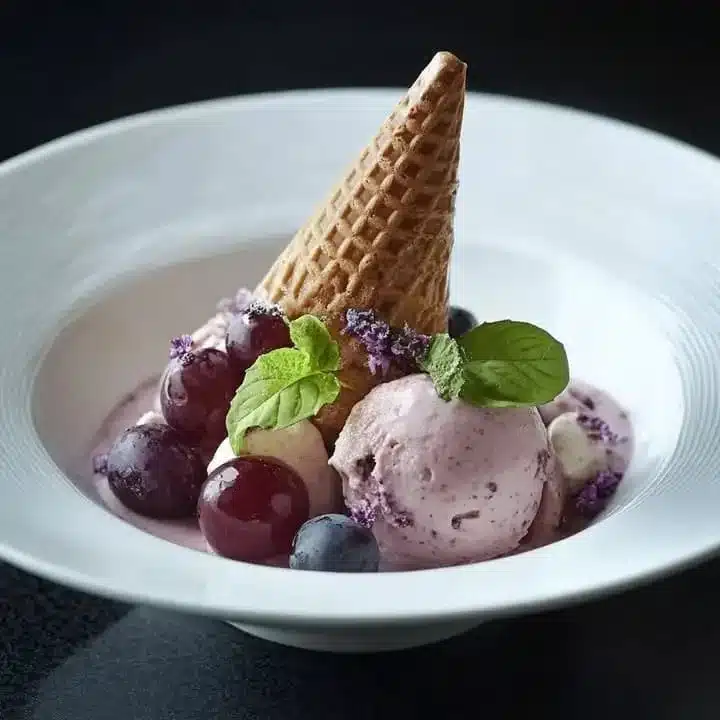
Grape Ice Cream: Ultimate Homemade Recipe
Bright, floral, and luxuriously smooth, grape ice cream tastes like late summer in a spoon. Grape ice cream starts with pure grape purée and a silky custard base that keeps the texture creamy and stable. I perfected this version after testing it eight times with Concord, red globe, and table grapes at home and in restaurant kitchens. The method balances fruit intensity and mouthfeel so the flavor stays bright without turning icy. Read on for a clear, tested process, exact weights and temperatures, and tips I learned while developing this at a seasonal dessert menu. If you love fruit-based frozen treats, you’ll also enjoy these old-fashioned ice cream recipes for more inspiration.
Why This Recipe Works
- Use of grape purée concentrates flavor without adding too much extra sugar, preserving natural tartness.
- A cooked custard base with egg yolks and milk gives body and prevents ice crystals, so the texture stays creamy.
- Light stabilization from a small amount of corn starch (or cornstarch) helps the ice cream soften sooner after freezing.
- Rapid chilling and proper churn speed introduce small air cells, making the finished ice cream scoopable yet dense.
- Balancing acid (lemon juice) brightens grape flavor and prevents flatness when frozen.
Ingredients Breakdown
- Grapes (700 g / about 4 cups fresh grapes, stems removed): The flavor backbone. Concord grapes give a jammy, floral note; table grapes are cleaner and milder. If using Concord, reduce added sugar by 10–15%.
- Granulated sugar (150 g / 3/4 cup): Sweetens and lowers freezing point. Reducing sugar will make the ice cream firmer.
- Whole milk (240 ml / 1 cup): Thins the custard and keeps flavor clean.
- Heavy cream (480 ml / 2 cups): Adds fat for creaminess and mouthfeel. Substituting half-and-half makes a lighter but less smooth ice cream.
- Egg yolks (6 large): Create a rich custard and add emulsifying proteins that prevent ice crystals.
- Cornstarch (10 g / 1 tablespoon): Small stabilizer to reduce iciness. You can omit for a purer ingredient list but expect slightly firmer texture.
- Lemon juice (15 ml / 1 tablespoon): Brightens grape flavor and balances sweetness.
- Fine sea salt (1/4 tsp / 1.5 g): Enhances sweetness and depth.
- Optional vodka (15 ml / 1 tablespoon): Lowers freezing point slightly to keep the ice cream scoopable straight from the freezer. Omit for alcohol-free version.
Substitutions with impact warnings:
- Milk alternatives: Use full-fat coconut milk for dairy-free; flavor will shift and texture may be slightly denser.
- Sugar substitutes: Using liquid sweeteners like honey changes freezing properties and sweetness intensity — reduce other liquid slightly.
- If using Morton’s kosher salt instead of Diamond Crystal, halve the quantity because Morton’s is denser.
Essential Equipment
- Blender or food processor for puréeing grapes.
- Fine-mesh sieve to strain seeds and skin for a silky purée.
- Medium heavy-bottomed saucepan (2–3 L) for cooking custard and purée.
- Instant-read thermometer (or candy thermometer) accurate to 1°C for precise custard temperature.
- Ice cream maker (home churner) or a large food processor as a poor-man’s churn substitute.
- Medium bowl set in an ice bath to cool custard quickly.
- Airtight container for freezing (best: metal loaf pan with plastic wrap pressed to surface).
If you don’t have an ice cream maker, use a saucepan-churn method: freeze custard in a shallow metal pan and beat vigorously every 30 minutes until frozen. It takes longer and yields more coarse crystals, but it works.
Step-by-Step Instructions
This recipe yields 6 servings (1/2 cup / 120 ml per serving). Active prep: 20 minutes; cook time: 15 minutes; inactive chilling: 6 hours; total time: about 6 hours 35 minutes.
Step 1: Prepare and purée the grapes
Pick 700 g (about 4 cups) seedless grapes and rinse. Cook grapes in a saucepan with 30 g (2 tbsp) sugar and 30 ml (2 tbsp) water over medium heat until they burst, about 6–8 minutes, stirring every minute. Purée the warm grapes in a blender, then pass through a fine-mesh sieve, pressing to extract as much liquid as possible; you should have about 350–400 ml (1½–1¾ cups) of purée.
Step 2: Make the custard base
Warm 240 ml (1 cup) whole milk and 480 ml (2 cups) heavy cream with a pinch of salt in a medium saucepan until steam rises and small bubbles form at the edge, about 5–6 minutes. Whisk 6 egg yolks with 150 g (3/4 cup) sugar and 10 g (1 tbsp) cornstarch in a bowl until smooth.
Step 3: Temper the eggs
Slowly pour one-third of the hot milk mixture into the yolks while whisking constantly to raise their temperature without scrambling, about 1 minute. Then pour the yolk mix back into the saucepan with the remaining milk and cream.
Step 4: Thicken the custard
Cook the mixture over medium-low heat, stirring constantly with a wooden spoon, until it thickens and reaches 80°C (176°F), about 4–6 minutes. The custard should coat the back of a spoon and leave a clear line when you run your finger through it. Do not boil. Overheating will break the custard.
Step 5: Combine fruit and custard, add acid
Remove the pan from heat. Stir in the grape purée (350–400 ml), 15 ml (1 tbsp) lemon juice, and 15 ml (1 tbsp) vodka if using. Taste and add up to 30 g (2 tbsp) additional sugar if the grapes are tart. Cool the mixture slightly for 5 minutes.
Step 6: Rapid chill and rest
Place the saucepan in an ice bath and stir for 6–8 minutes until the mixture drops below 10°C (50°F). Cover with plastic wrap pressed on the surface and refrigerate for at least 4–6 hours or overnight. Chilling is critical—it helps flavors meld and improves churn texture.
Step 7: Churn the ice cream
Churn in your ice cream maker according to the manufacturer’s instructions, about 20–30 minutes, until it reaches a soft-serve consistency. If you’re using the freeze-and-stir method, freeze in a shallow pan and beat every 30 minutes for 2–3 hours.
Step 8: Harden and store
Transfer to an airtight container and press plastic wrap directly onto the surface to prevent ice crystals. Freeze for at least 3 hours to firm up before serving. For best texture, let it sit at room temperature for 5–10 minutes before scooping.
Expert Tips & Pro Techniques
- Always strain the grape purée. Tiny skins or seeds cause graininess. Use a spatula to press through the sieve.
- Common mistake: Skipping rapid chill. If custard isn’t cold before churning, the machine overworks and makes icy texture. Chill thoroughly.
- Control sweetness with tasting. Grapes vary widely; adjust sugar after mixing purée and custard.
- Make-ahead: Custard base keeps 48 hours in the fridge. Churn just before serving for best texture. You can also churn and refreeze up to 2 weeks.
- Professional trick: Add 1 tsp of glucose syrup or invert sugar (20 g) to keep texture softer at freezer temps. It prevents the ice cream from freezing rock-hard.
- For a more intense grape color, add a spoon of grape concentrate rather than extra sugar.
- If you don’t have an ice cream maker, freeze in a shallow pan and whisk every 20–30 minutes until smooth. It takes longer but reduces ice crystals compared with static freezing.
Storage & Reheating
- Refrigerator: Homemade ice cream must stay frozen; do not store in the fridge. If you have leftover grape custard (before churning), keep it refrigerated in a sealed container for up to 48 hours.
- Freezer: Grape ice cream freezes well for up to 2 weeks in an airtight, shallow metal pan. For longer storage (up to 3 months) use a rigid airtight container and double-wrap with plastic wrap and foil to prevent freezer burn. The texture will firm with longer freezing.
- Reheating: Not applicable — do not microwave. To serve, let frozen ice cream sit at room temperature for 5–10 minutes (depending on freezer temperature) to soften. For very hard ice cream, move the container to the refrigerator for 20–30 minutes instead.
Variations & Substitutions
- Vegan Version: Replace dairy with 400 ml (1¾ cups) full-fat coconut milk and 320 ml (1⅓ cups) almond or oat milk; swap egg yolks for 30 g (2 tbsp) cornstarch more and 20 g (1½ tbsp) tapioca syrup. Churn as usual; texture will be slightly different.
- Concord Grape Sorbet: Use only grape purée (700 g grapes cooked), 200 g (1 cup) sugar, 30 ml (2 tbsp) lemon juice, and 120 ml (1/2 cup) water. Chill and churn without dairy for a bright, dairy-free sorbet. No eggs or cream needed.
- Boozy Grape Ripple: After churning, fold in 60–80 ml (1/4–1/3 cup) grape liqueur reduced by simmering to a syrup. Freeze briefly to set. Alcohol adds scoopability.
- Reduced-Sugar: Substitute 50 g (1/4 cup) of the sugar with 30 g (2 tbsp) erythritol. Expect slightly firmer texture; serve a few minutes longer at room temperature.
Serving Suggestions & Pairings
- Serve with a crisp amaretti cookie for texture contrast and almond notes.
- Pair with a dry prosecco or a light Riesling to echo grape aromas.
- Garnish with crushed toasted pistachios and a drizzle of honey for richness.
- Try alongside our rose pistachio cheesecake ice cream ideas for a layered dessert plate.
Nutrition Information
Per serving (1/2 cup / 120 ml). Recipe makes 6 servings.
- Calories: 330 kcal
- Total Fat: 21 g
- Saturated Fat: 12 g
- Cholesterol: 205 mg
- Sodium: 55 mg
- Total Carbohydrates: 32 g
- Dietary Fiber: 1 g
- Sugars: 28 g
- Protein: 5 g
Nutrition values are estimates. Actual values may vary based on specific ingredients and portion sizes.
Frequently Asked Questions
Q: Why did my grape ice cream turn out icy?
A: The most common cause is not chilling the custard fully before churning. Also, too little fat or too much added water will make icy crystals. Chill the base down to under 10°C (50°F) and consider adding 1 tbsp corn syrup or glucose to reduce iciness.
Q: Can I make this without eggs?
A: Yes. Replace the eggs by mixing 25–30 g (2 tbsp) cornstarch with a little milk, whisk into the warmed dairy, and cook until thickened. Expect a slightly less rich mouthfeel but good stability.
Q: Can I double this recipe?
A: Yes. Double all ingredients and use a suitably large saucepan. Chill thoroughly and churn in batches if your ice cream maker cannot handle the full volume. Doubling may increase chilling time.
Q: Can I prepare this the night before?
A: Absolutely. Make the custard and grape purée the day before, chill overnight, then churn the next day. This often improves flavor integration.
Q: How long does this keep in the freezer?
A: For best texture and flavor, use within 2 weeks. Properly wrapped, it can last up to 3 months but will gradually lose brightness and may develop firmer texture.
Q: Can I use frozen grapes?
A: Yes, but thaw and drain them first. They yield more water than fresh grapes. You may need to simmer longer to reduce excess liquid and concentrate flavor.
Q: My grape ice cream tastes flat. How can I fix that?
A: Add a splash (1 tbsp) of lemon juice to brighten the flavor before chilling. Small acid adjustments help fruit flavors pop when cold.
Conclusion
Grape ice cream is a delightful seasonal twist on classic custard-style ice cream. For more seasonal inspiration that complements this dessert, check out this best recipes for summer roundup. If you want to explore a different, old-school flavor technique, David Lebovitz’s Brown Bread Ice Cream offers a masterclass in turning simple pantry ingredients into something extraordinary.
Print
Grape Ice Cream
- Total Time: 395 minutes
- Yield: 6 servings 1x
- Diet: Vegetarian
Description
Bright, floral, and luxuriously smooth, grape ice cream tastes like late summer in a spoon, made with a silky custard base and pure grape purée.
Ingredients
- 700 g fresh grapes, stems removed (about 4 cups)
- 150 g granulated sugar (3/4 cup)
- 240 ml whole milk (1 cup)
- 480 ml heavy cream (2 cups)
- 6 large egg yolks
- 10 g cornstarch (1 tablespoon)
- 15 ml lemon juice (1 tablespoon)
- 1/4 tsp fine sea salt (1.5 g)
- 15 ml vodka (1 tablespoon, optional)
Instructions
- Pick and rinse grapes. Cook in a saucepan with 30 g sugar and 30 ml water over medium heat until they burst, about 6–8 minutes. Purée grapes and strain through a fine-mesh sieve.
- Warm milk, cream, and salt in a saucepan until steam rises. Whisk egg yolks, sugar, and cornstarch until smooth.
- Temper eggs by slowly adding hot milk mixture while whisking.
- Cook mixture on low heat until thickened to 80°C (176°F), stirring constantly.
- Stir in grape purée, lemon juice, and vodka if using. Cool for 5 minutes.
- Place saucepan in an ice bath, stir until below 10°C (50°F), cover, and refrigerate for 4–6 hours.
- Churn in an ice cream maker according to directions until soft-serve consistency is reached.
- Transfer to an airtight container, press plastic wrap onto the surface, and freeze for at least 3 hours before serving.
Notes
For best texture, let ice cream sit at room temperature for 5–10 minutes before scooping. Can be made ahead and stored in the freezer for up to 2 weeks.
- Prep Time: 20 minutes
- Cook Time: 15 minutes
- Category: Dessert
- Method: Churning
- Cuisine: American
Nutrition
- Serving Size: 1/2 cup (120 ml)
- Calories: 330
- Sugar: 28g
- Sodium: 55mg
- Fat: 21g
- Saturated Fat: 12g
- Unsaturated Fat: 9g
- Trans Fat: 0g
- Carbohydrates: 32g
- Fiber: 1g
- Protein: 5g
- Cholesterol: 205mg

Written by Chef Anna
I'm Anna - a Le Cordon Bleu-trained chef, recipe developer, and the voice behind Chef Johns Gourmet. After a decade in professional kitchens, I now spend my mornings testing recipes and my afternoons writing them down so you can make them perfectly in your own kitchen. Every one of the 1,100+ recipes on this site has been personally cooked, tasted, and refined. I write like I'm standing next to you, walking you through every step. Simple recipes. Bold flavors. Made for real kitchens.