
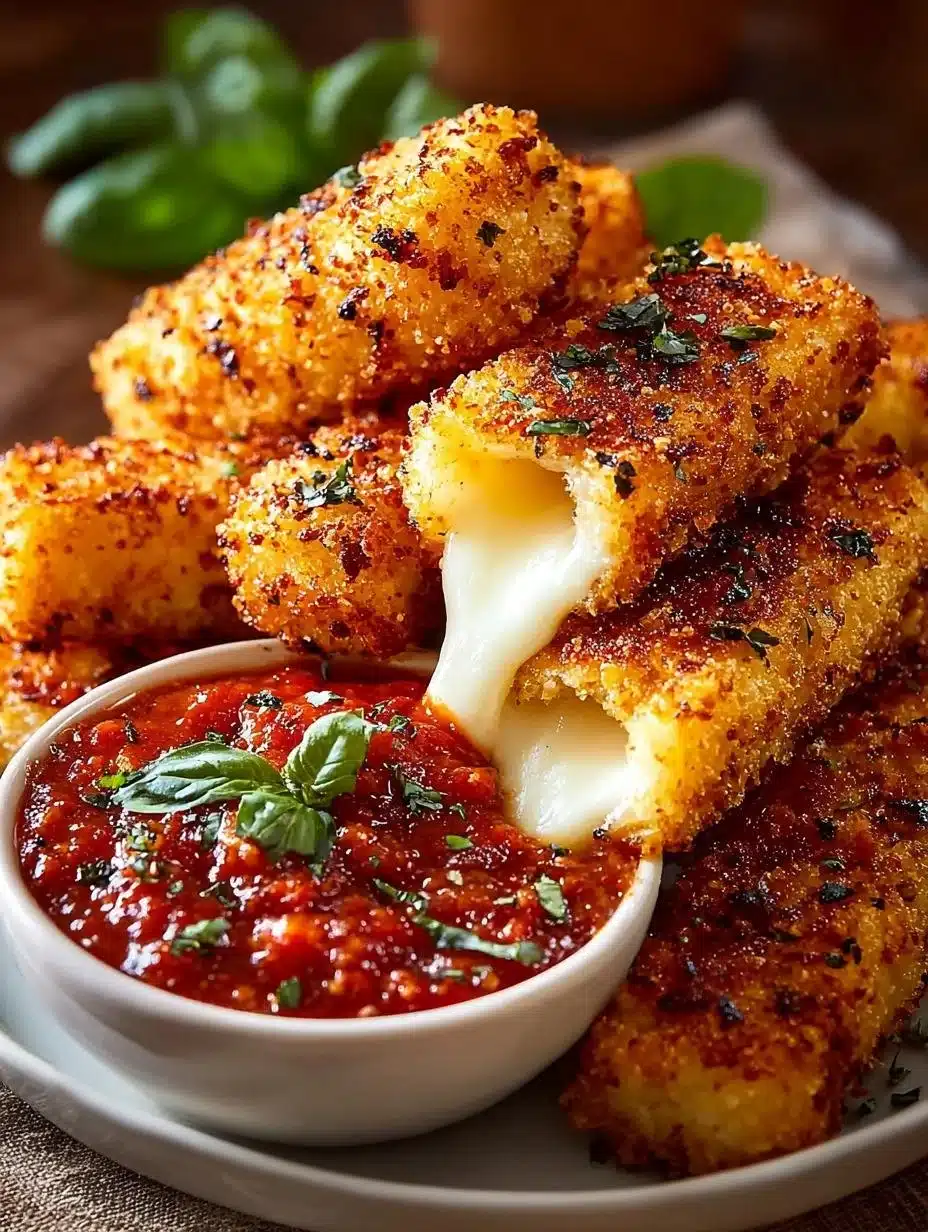
Key Takeaways
- Crispy mozzarella sticks require a double breading and a freezer step — these are the two non-negotiable secrets that prevent cheese leakage.
- Use low-moisture, part-skim mozzarella string cheese (not fresh mozzarella) — its lower moisture and structured protein hold their shape during frying.
- Freeze for at least 2 hours (preferably overnight) before frying — frozen cheese melts slowly enough to develop a golden crust before exploding.
- Optimal frying temperature is 365-375°F (185-190°C) for 60-90 seconds — too cool and oil seeps in; too hot and the crust burns before the cheese melts.
- Air fryer and oven methods both work — air fryer at 400°F for 6-7 minutes; oven at 425°F for 8-10 minutes on a wire rack.
Crispy mozzarella sticks are arguably the most beloved and most frequently ruined appetizer in American cuisine. Restaurant versions are often disappointing — soggy, greasy, with cheese that either hasn’t melted or has explosively leaked into the fryer. Homemade versions can be even worse, with home cooks watching helplessly as their carefully breaded cheese turns into puddles of oily mozzarella in the pan. The difference between disaster and triumph isn’t talent — it’s understanding the specific science behind cheese frying.
The good news: once you understand the technique, mozzarella sticks become reliably foolproof. The double-breading technique creates an armor that contains the cheese during melting. The freezing step ensures the cheese melts at the right pace relative to the crust forming. Get these two elements right and you’ll produce restaurant-beating mozzarella sticks every single time. The same systematic approach makes our healthy garlic Parmesan chicken and crispy Spanish fried sardines consistently excellent.
The Science Behind Why Mozzarella Sticks Fail
Most mozzarella stick failures trace back to one of three causes: wrong cheese, insufficient breading, or wrong temperature. Each fails the cheese in a different way, but the result is the same — molten cheese escapes through gaps in the breading, leaving you with hollow breaded shells and an oily mess.
Cheese Selection Matters Enormously
Not all mozzarella works for frying. Fresh mozzarella (the kind packed in water) contains 60-70% moisture and a delicate protein structure — it’ll explode in the fryer. Low-moisture, part-skim mozzarella (the string cheese kind) contains 45-50% moisture and a tightly-coiled protein structure that holds shape better during melting. This is the only cheese that reliably works for traditional mozzarella sticks.
The Breading Acts as Armor
Single breading (one egg + one breadcrumb pass) is insufficient — it creates gaps and weak spots. Double breading (two complete passes) creates a thick, multi-layered armor that can survive both the freezing-thawing cycle and the heat of frying. The flour in the first dredge dries the cheese surface so the egg adheres; the egg helps the breadcrumbs stick; the second pass fills gaps left by the first.
Temperature Timing Is Everything
The cheese needs to melt fully without escaping. The crust needs to brown enough to look appetizing without burning. These two needs must be balanced. Frozen cheese starts at -18°C; it needs to reach about 70°C (158°F) to melt enticingly. The breading needs to reach golden-brown color (about 160°C internally on the surface) without scorching. Frying at 365-375°F for 60-90 seconds achieves both targets simultaneously.
The Master Recipe
This recipe yields 12 mozzarella sticks, perfect for 4 people as appetizer or 2 as snack. Active time is 25 minutes; total time including freezing is 2.5 hours minimum (overnight is even better).
Ingredients
12 sticks low-moisture part-skim mozzarella string cheese, 1 cup all-purpose flour, 1 teaspoon garlic powder, 1 teaspoon kosher salt, 1/2 teaspoon black pepper, 3 large eggs, 2 tablespoons milk, 2 cups Italian-seasoned panko breadcrumbs, 1/2 cup grated Parmesan cheese, 1 teaspoon dried oregano, 1 teaspoon dried basil, vegetable oil for frying (about 4 cups for deep frying or 1 cup for shallow frying).
Step 1: Prepare the String Cheese
Cut each string cheese in half crosswise to create 24 shorter sticks (or leave whole for restaurant-size). Pat each piece completely dry with paper towels — this is more important than it sounds. Surface moisture prevents flour from adhering properly.
Step 2: Set Up the Breading Stations
Set up three shallow bowls in a line. Bowl 1: combine flour, garlic powder, salt, and pepper. Bowl 2: whisk eggs and milk together until smooth. Bowl 3: combine panko, Parmesan, oregano, and basil.
Step 3: Double-Bread Each Stick
Working with one stick at a time, dredge in flour to coat completely. Tap off excess. Dip into egg wash, letting excess drip off. Roll in breadcrumb mixture, pressing gently to adhere. Now repeat: back into the egg wash (no flour this time), then into the breadcrumbs again. Press firmly to ensure complete coverage.
Step 4: Freeze Thoroughly
Arrange breaded sticks on a parchment-lined baking sheet, not touching. Freeze 2 hours minimum, ideally overnight. They must be completely frozen solid before frying. Once frozen, they can be transferred to a freezer bag for storage up to 3 months.
Step 5: Fry to Golden Perfection
Heat oil to 365°F (185°C). Use a thermometer — guessing leads to failures. Fry sticks 4-5 at a time for 60-90 seconds, turning once if needed for even color. They’re done when golden brown and starting to bulge slightly (the cheese is melted). Drain on a wire rack (not paper towels — they cause sogginess).
Step 6: Serve Immediately
Mozzarella sticks are at their absolute peak within 2 minutes of frying. Serve with warm marinara sauce, ranch dressing, or honey mustard. Garnish with chopped parsley and grated Parmesan.
Cheese Comparison Guide
Different cheeses behave very differently in the fryer. Understanding which work for traditional sticks and which work for variations expands your repertoire.
| Cheese Type | Moisture % | Behavior in Fryer | Best Use |
|---|---|---|---|
| Low-moisture mozzarella (string cheese) | 45-50% | Holds shape, melts cleanly | Classic mozzarella sticks |
| Part-skim block mozzarella | 45-50% | Good but cut sticks may leak | Cut into strips for variety |
| Whole-milk block mozzarella | 50% | Melts faster, riskier | Use only with overnight freeze |
| Fresh mozzarella (water-packed) | 60-70% | EXPLODES in fryer | Never fry; serve fresh only |
| String cheese (knock-off brands) | varies | Inconsistent; check before buying | Stick with name brands |
| Provolone | 40-45% | Holds shape; nutty flavor | Adult variation |
| Cheddar | 40% | Melts unevenly; oilier | Cheddar bites variation |
| Halloumi | ~40% | Squeaky texture; doesn’t fully melt | Mediterranean variation |
Choosing the Right Breadcrumbs
Breadcrumb selection dramatically affects final texture. Different types produce different crispness levels and flavor profiles. Match the breadcrumb to your priorities.
| Breadcrumb Type | Texture Result | Flavor | Best For |
|---|---|---|---|
| Panko (Japanese) | Extra crispy, light | Neutral; takes seasoning well | Best overall choice |
| Italian-seasoned panko | Crispy with herbs | Italian herb profile | Quick prep convenience |
| Regular fine breadcrumbs | Smooth, less crispy | Bready | Smaller bites; finger food |
| Italian-seasoned regular | Smooth with herbs | Pre-seasoned | Quick weeknight version |
| Cornflake crumbs | Very crunchy, golden | Sweet, distinct | Sweet-savory variation |
| Crushed Ritz crackers | Buttery crisp | Buttery, salty | Indulgent variation |
| Almond meal | Tender, slightly crisp | Nutty | Low-carb / gluten-free |
| Crushed pork rinds | Very crisp, salty | Bacon-like | Keto / carnivore version |
Frying Method Comparison
Mozzarella sticks can be cooked four different ways, each with trade-offs. Choose based on equipment, dietary preferences, and how much hands-on time you have.
| Method | Temperature | Time | Texture Result | Calories per stick |
|---|---|---|---|---|
| Deep fry (oil) | 365-375°F | 60-90 sec | Crispiest, most golden | ~145 |
| Shallow pan fry | 365°F | 2-3 min, turn | Crispy, slight uneven color | ~120 |
| Air fryer | 400°F | 6-7 min | Crispy, less greasy | ~95 |
| Oven on wire rack | 425°F | 8-10 min | Less crispy but acceptable | ~85 |
| Convection oven | 425°F | 7-9 min | Better than regular oven | ~85 |
| Toaster oven | 425°F | 9-11 min | Decent for small batches | ~85 |
| Grilled (skewered) | medium-high | 2 min, turn | Smoky, unique flavor | ~85 |
| Microwave (no) | N/A | N/A | EXPLODES; do not attempt | N/A |
The Perfect Dipping Sauces
Mozzarella sticks are 50% breaded cheese and 50% the dipping sauce. The right sauce elevates good sticks into great ones. Make at least two for variety. The same approach works for our cheeseburger pizza and sheet pan shrimp fajitas.
Classic Marinara Sauce
The traditional pairing. Heat 1 cup quality marinara with 1 clove minced garlic, 1/4 teaspoon red pepper flakes, and 1 tablespoon fresh basil. Simmer 5 minutes. Serve warm in small ramekins.
Honey Mustard
Whisk 1/4 cup honey, 1/4 cup Dijon mustard, 2 tablespoons mayonnaise, 1 tablespoon apple cider vinegar, and 1/4 teaspoon paprika. Sweet, tangy, addictive contrast to the savory sticks.
Ranch Dressing
Whisk 1/2 cup mayo, 1/2 cup buttermilk, 1 teaspoon dried dill, 1 teaspoon garlic powder, 1 teaspoon onion powder, 1 tablespoon fresh chives, salt and pepper. Refrigerate 30 minutes for flavors to develop.
Sriracha Mayo
Mix 1/2 cup mayo, 2 tablespoons sriracha, 1 teaspoon lime juice, 1/2 teaspoon honey. Adjust sriracha to taste. Modern, spicy, perfect for grown-up parties.
Common Problems and Solutions
Even with this recipe, things can go wrong. Here’s how to diagnose and prevent the most frequent mozzarella stick disasters.
| Problem | Cause | Solution |
|---|---|---|
| Cheese leaks during frying | Insufficient freezing or single breading | Freeze 2+ hours; always double bread |
| Crust burns before cheese melts | Oil too hot | Maintain 365-375°F; use thermometer |
| Greasy, soggy texture | Oil too cool; food crowds pan | Maintain 365°F; fry 4-5 at a time max |
| Breading falls off | Cheese surface not dried; rushed breading | Pat cheese dry; press breading firmly |
| Cheese hard/not melted | Fried too short or too cold oil | Increase fry time 30 sec; check oil temp |
| Hollow inside (no cheese) | Cheese leaked out during frying | See first row — freeze and double bread |
| Pale, not golden | Oil too cool or not enough time | Heat to 375°F; cook full 90 seconds |
| Uneven color | Didn’t turn during frying | Flip once during cooking time |
Make-Ahead and Freezer Strategy
Mozzarella sticks are the ideal freezer food. Bread a triple batch, freeze on a tray until solid, then transfer to a freezer bag. Pull out and fry as many as you need for movie night, party appetizers, or impromptu cravings. They cook directly from frozen — no thawing required.
Best Storage Method
Lay frozen breaded sticks in a single layer on parchment paper inside a freezer bag. This prevents them from sticking together. Mark the bag with the date. They keep up to 3 months at peak quality, longer if vacuum-sealed. Always fry from frozen — never thaw, which ruins the breading and increases leakage risk.
Restaurant-Style Pre-Fry Method
For party preparation: fry sticks at 350°F for 60 seconds (just long enough to set the breading without melting cheese). Drain and refrigerate up to 4 hours. Just before serving, fry again at 375°F for 30-45 seconds for the final crisp and cheese melt. This is exactly what restaurants do during their dinner rush.
For more crispy fried foods, explore our crispy tofu, our canned sardine fish cakes, our crispy Spanish fried sardines, or pair with our perfect garlic bread. They’re an excellent appetizer before our delicious vegetable lasagna.
Mozzarella Sticks Around the World
While Americans claim mozzarella sticks as their own, fried cheese has a much older and more global tradition. The American version (breaded mozzarella, fried, dipped in marinara) became popular in the 1980s through chain restaurants like TGI Fridays and Chili’s, but variations exist throughout the world. Understanding these international counterparts opens up creative possibilities for your home cooking.
| Country | Local Name | Cheese Used | Preparation | Typical Accompaniment |
|---|---|---|---|---|
| USA | Mozzarella sticks | Low-moisture mozzarella | Breaded sticks, deep-fried | Marinara sauce |
| Czech Republic | Smaeny syr | Edam or hermelin | Whole slice, breaded, fried | Tartar sauce, fries |
| Italy | Mozzarella in carrozza | Fresh mozzarella in bread | Sandwich-fried in egg batter | Anchovy sauce |
| Cyprus | Saganaki halloumi | Halloumi | Pan-fried slices | Lemon, oregano |
| Greece | Saganaki | Kefalotyri or kasseri | Flour-dusted, pan-fried | Lemon juice, ouzo flame |
| India | Cheese pakora | Paneer | Chickpea batter, deep-fried | Mint chutney |
| Mexico | Queso frito | Queso panela or Oaxaca | Pan-fried slices | Salsa verde, tortillas |
| Korea | Cheese hot dog | Mozzarella core | Battered, deep-fried, sugar-coated | Ketchup, mustard |
Hosting a Mozzarella Sticks Party
Mozzarella sticks are quintessential party food. They’re impressive without being intimidating, recognizable to every guest, and can be prepared days ahead and fried fresh as guests arrive. Plan on 4-6 sticks per person as appetizer, plus 2-3 different dipping sauces for variety and visual appeal on the buffet table.
For a party of 8-10 people, prepare 60-80 mozzarella sticks (5 batches of the master recipe). Bread and freeze them up to a week ahead. The day of the party, set up a small frying station in your kitchen with a heavy pot, thermometer, oil, and a wire rack with paper towels underneath. As guests arrive, fry batches every 15-20 minutes throughout the cocktail hour. The sound and smell of frying creates an inviting, restaurant-like atmosphere that signals “this is going to be a great party.”
For variety, fry 60% classic mozzarella sticks plus 40% variations: provolone sticks for adult palates, halloumi sticks for Mediterranean flair, or pepper jack sticks for spice lovers. Set up a “dipping sauce bar” with 4-5 sauces in small ramekins, each labeled. Provide picks or small skewers for easy grabbing. Pair with cold beer (lagers and pilsners cut the richness) or sparkling wine (Prosecco is ideal). Your guests will rave about it for months.
The Final Word on Mozzarella Stick Mastery
The difference between a home cook who occasionally makes mozzarella sticks and one who consistently produces restaurant-quality results comes down to respecting the process. Don’t shortcut the freezing step, even when you’re in a rush. Don’t skip the second breading pass, even when the first one looks perfect. Don’t fry without a thermometer, even if you’ve fried a hundred batches before. These three rules, followed religiously, virtually eliminate failures.
Once you’ve made the master recipe four or five times, you’ll develop your own intuitions about timing and technique. You’ll start to recognize the exact shade of golden brown that means perfect doneness. You’ll learn how your particular oven, stovetop, or air fryer behaves. You’ll experiment with breadcrumb mixes (Italian panko plus regular panko produces a beautiful blend of texture). You’ll discover that certain pasta sauces from a jar make excellent emergency marinara dips when you don’t have time to make sauce from scratch. This personal evolution from following a recipe to embodying a technique is the real reward of cooking, and mozzarella sticks are an unusually generous teacher because the feedback loop is so immediate and satisfying.
Pairing Mozzarella Sticks with Movies and Game Day
Mozzarella sticks are perhaps the ultimate movie night and game day food. Their hand-held format requires no plates or utensils. They reheat acceptably during halftime if guests want a second round. The dipping sauces add interactive engagement that keeps the food experience going beyond simple consumption. For the perfect couch viewing experience, pair sticks with cold lager beer, an action movie or sports broadcast, and at least three different dipping sauces lined up on the coffee table. Sometimes the simplest pleasures are also the most enduring.
Quick History of the American Mozzarella Stick
The American restaurant mozzarella stick we know today was popularized in the early 1980s by chains like TGI Fridays and Bennigans, who marketed them as the quintessential casual dining appetizer alongside potato skins and chicken wings. Their popularity exploded throughout that decade and the next, becoming a fixture on virtually every American chain restaurant menu. Frozen versions hit grocery store shelves in the late 1980s, bringing the craze into home kitchens nationwide. Today, mozzarella sticks remain one of the top-five most ordered restaurant appetizers in America according to industry surveys, with hundreds of millions of sticks consumed annually across casual dining establishments. Their staying power proves that some food trends transcend trendiness to become genuine culinary classics that families and friends will gather around for many decades to come throughout this and future generations of food lovers everywhere.
Frequently Asked Questions
What’s the secret to crispy mozzarella sticks?
Two non-negotiable secrets: double breading (two complete passes through egg and breadcrumbs) and freezing for 2+ hours before frying. Skip either and your cheese will leak out, leaving you with hollow breaded shells.
Why do my mozzarella sticks explode in the fryer?
Three causes: wrong cheese (use low-moisture string cheese, not fresh mozzarella), insufficient freezing (must be solid, not just chilled), or single breading (always double bread). Fix all three for foolproof results.
What kind of cheese works best for frying?
Low-moisture, part-skim mozzarella string cheese is ideal. Its 45-50% moisture content and tightly-coiled protein structure hold shape during melting. Avoid fresh mozzarella (60-70% moisture; will explode) and pre-shredded mozzarella (anti-caking agents prevent good melting).
Can I bake mozzarella sticks instead of frying?
Yes — bake at 425°F on a wire rack over a baking sheet for 8-10 minutes. They won’t be as crispy as fried, but they’ll be acceptable. Air fryer at 400°F for 6-7 minutes produces results closer to fried (crispier than oven-baked).
How do I prevent breading from falling off?
Pat cheese completely dry before flouring (moisture is the enemy of adhesion). Press breadcrumbs firmly onto cheese during both passes. Freeze thoroughly before frying. Don’t move the sticks in the fryer until the crust has set (about 30 seconds).
What oil temperature should I use?
365-375°F (185-190°C) is the sweet spot. Below 365°F, oil seeps into the breading and produces greasy results. Above 375°F, the crust burns before the cheese melts. Always use a thermometer — don’t guess.
How long do I fry mozzarella sticks?
60-90 seconds total at 365-375°F. They’re done when golden brown and slightly bulging (the cheese is melted). Don’t overcook — the cheese will leak through any weak points in the breading once it’s fully liquid.
Can I freeze mozzarella sticks ahead of time?
Yes — in fact, freezing is part of the recipe. Bread, freeze on a parchment-lined tray until solid, then transfer to a freezer bag. They keep up to 3 months. Fry directly from frozen — never thaw first.
What’s the best dipping sauce?
Classic marinara is traditional and pairs perfectly. Other excellent options: honey mustard (sweet contrast), ranch dressing (cooling), sriracha mayo (spicy modern), or a quick garlic aioli. Serve at least two sauces for variety.
Why are restaurant mozzarella sticks better than mine?
Restaurants use the pre-fry method (fry once at 350°F, refrigerate, then re-fry at 375°F for service) and have powerful commercial fryers that recover temperature instantly when food is added. Replicate by using enough oil (2+ inches deep), using a thermometer, and frying small batches.

Written by Chef Anna
I'm Anna - a Le Cordon Bleu-trained chef, recipe developer, and the voice behind Chef Johns Gourmet. After a decade in professional kitchens, I now spend my mornings testing recipes and my afternoons writing them down so you can make them perfectly in your own kitchen. Every one of the 1,100+ recipes on this site has been personally cooked, tasted, and refined. I write like I'm standing next to you, walking you through every step. Simple recipes. Bold flavors. Made for real kitchens.