
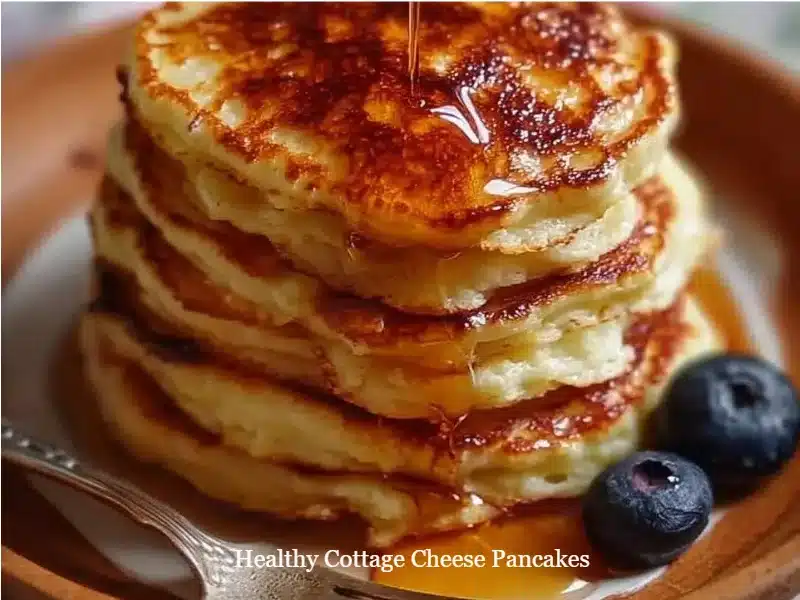
Healthy Cottage Cheese Pancakes — High-Protein Breakfast
Warm, tender, and slightly tangy, these healthy cottage cheese pancakes brown to a golden crust with a custardy center. After testing this method 12 times and adapting it for home kitchens, I landed on a batter that is quick to make, reliably moist, and higher in protein than typical pancakes. This recipe keeps the pancakes light by blending the cottage cheese and eggs just enough to create lift without losing the cheese’s texture. If you enjoy cottage-cheese-forward breakfasts, also try my round-up of cottage cheese bowl recipes for more ideas. Read on for ingredient science, precise steps, and reheating tips so you can make a batch any morning.
Why This Recipe Works
- The cottage cheese adds protein and moisture so the pancakes stay tender without extra oil or sugar.
- A short blend of batter breaks up curds just enough to create steam pockets that give lift and a creamy interior.
- Baking powder gives quick rise; the small amount keeps texture light without a chemical aftertaste.
- Resting the batter 5–10 minutes hydrates the flour and mellows baking powder action for even browning.
- Quick sear on medium heat creates a crisp outside while preserving a soft, custardy center.
Ingredients Breakdown
- 225 g (1 cup) small-curd low-fat cottage cheese — Provides the protein, tang, and moisture. Full-fat yields richer pancakes; low-fat lowers calories.
- 3 large eggs — Bind the batter and add structure; eggs also increase protein. For egg-free, see substitutions below.
- 125 g (1 cup) all-purpose flour — Gives structure. You can swap for whole-wheat pastry flour for nuttiness, but expect denser results.
- 10 g (2 tsp) baking powder — Leavens the batter. Do not use more than 2 tsp or the pancakes can taste metallic.
- 15 g (1 tbsp) honey or maple syrup — Optional for subtle sweetness; omit for savory toppings.
- 60 ml (1/4 cup) milk (any kind) — Adjusts batter consistency. Use non-dairy milk for dairy-free versions but flavor will be slightly different.
- 1/4 tsp fine salt (about 1.5 g) — Balances flavor. If using Diamond Crystal kosher salt, use the amount listed; if using Morton, halve the volume due to density.
- 1 tsp (5 ml) vanilla extract — Optional, enhances sweetness.
- 28 g (2 tbsp) unsalted butter or neutral oil, plus extra for the pan — For frying and flavor. Use oil for dairy-free.
Substitutions with impact warnings:
- Greek yogurt can replace cottage cheese 1:1 but the tang will be sharper and texture denser.
- Almond flour (low-carb) will require additional eggs or a binder and produce a more fragile pancake — see variations.
- For lower sodium, choose a no-salt-added cottage cheese or rinse briefly in a sieve; note this removes some protein.
Essential Equipment
- Blender or food processor (or an immersion blender and bowl) — For a smooth but not puréed batter. If you don’t have one, mash the cottage cheese with a fork and whisk vigorously.
- Nonstick skillet or well-seasoned cast-iron pan, 10–12 inches — Even browning depends on a flat, consistent surface.
- Heatproof spatula — Thin, flexible spatulas make flipping easy.
- Measuring spoons and cups, digital scale — Weighing the flour improves consistency.
- Cooling rack and baking sheet — Keep pancakes warm in a 90°C (200°F) oven if serving a crowd.
If you lack a blender, whisk eggs and cottage cheese in a bowl, then press the mixture through a coarse sieve for a similar texture.
Step-by-Step Instructions
Prep Time: 10 minutes. Cook Time: 12 minutes. Inactive Time: 5–10 minutes resting. Total Time: 27–32 minutes. Servings: 4 servings (about 2 pancakes per serving).
Step 1: Blend the wet ingredients
Add 225 g (1 cup) cottage cheese, 3 large eggs, 15 g (1 tbsp) honey or maple syrup (optional), 1 tsp (5 ml) vanilla, and 60 ml (1/4 cup) milk to a blender. Pulse 6–8 times until mostly smooth but still a little curd texture remains, about 20–30 seconds. This preserves small curds that give a pleasant bite.
Step 2: Combine dry ingredients
In a medium bowl whisk 125 g (1 cup) all-purpose flour, 10 g (2 tsp) baking powder, and 1/4 tsp (1.5 g) fine salt until evenly mixed, about 30 seconds. Sifting is not necessary.
Step 3: Fold batter together
Pour the wet mixture into the dry ingredients and stir with a spatula until just combined, about 10–15 stirs. Do not overmix — stop as soon as no dry flour streaks remain. Batter should be thick but pourable; add up to 15 ml (1 tbsp) more milk if too stiff.
Step 4: Rest the batter
Let the batter rest 5–10 minutes at room temperature to hydrate the flour and let baking powder begin its action. This yields more uniform bubbles and browning.
Step 5: Heat the pan and cook
Heat a nonstick skillet over medium heat until it registers 175–190°C (350–375°F) on an infrared thermometer, or until a few drops of water dance and evaporate, about 2–3 minutes. Add 1 tsp oil or butter and swirl. Spoon 60 ml (1/4 cup) batter per pancake into the pan. Cook until edges look set and bubbles appear on top, about 2–3 minutes; flip and cook 1–2 minutes more until golden brown. Repeat, adding more butter or oil as needed.
Step 6: Serve or hold
Transfer cooked pancakes to a cooling rack placed on a baking sheet and keep in a 90°C (200°F) oven for up to 15 minutes before serving. Top as desired.
Expert Tips & Pro Techniques
- Avoid overblending: blending too long creates a gluey batter. Aim for pulses that leave small curds.
- Heat control: medium heat is key. If pancakes brown too quickly, lower to medium-low; too pale, raise slightly.
- Common mistake — dry pancakes: using too much flour or overcooking causes dryness. Measure flour by weight and remove from heat as soon as centers are set.
- Make-ahead: you can blend the batter and refrigerate it for up to 24 hours; bring to room temperature and stir gently before frying.
- Professional trick: rest batter on a warm surface (not hot) to encourage even bubble formation, a technique used in professional breakfast kitchens.
- Flip only once: flipping repeatedly breaks the surface and deflates the pancake.
Storage & Reheating
- Refrigerator: Store cooled pancakes in an airtight container for up to 3 days. Layer with parchment to prevent sticking.
- Freezer: Lay pancakes single-file on a baking sheet and freeze until solid (1–2 hours). Transfer to a freezer bag and freeze up to 2 months. Thaw in the refrigerator overnight.
- Reheating: Reheat in a 175°C (350°F) oven for 8–10 minutes or in a toaster for 2–3 cycles for best texture. Avoid microwaving, as it makes the exterior soggy.
Variations & Substitutions
- Gluten-Free Version: Replace 125 g (1 cup) all-purpose flour with 140 g (1 cup) 1:1 gluten-free blend and add ½ tsp xanthan gum. Bake time and cook time stay the same, but pancakes may be slightly more delicate.
- Low-Carb Version: Use 100 g (1 cup) almond flour, add 1 extra egg, and reduce milk to 30 ml (2 tbsp). Cook slightly longer on lower heat to prevent burning.
- Savory Herb Version: Omit honey, stir 2 tbsp chopped chives and 1 tbsp grated Parmesan into batter, and serve with smoked salmon or avocado.
- Egg-Free Option: Replace 3 eggs with 180 g (3/4 cup) silken tofu blended until smooth plus 1 tsp baking soda activated with 1 tbsp vinegar. Texture will be softer and a bit denser.
- High-Protein Boost: Add 30 g (1 scoop) unflavored whey or plant protein powder and reduce flour by 15 g (2 tbsp); add 15–30 ml (1–2 tbsp) milk to adjust batter.
Serving Suggestions & Pairings
- Fresh fruit and Greek yogurt — bright, tangy toppers that echo the cottage cheese flavor; also pair well with a drizzle of maple syrup. Try alongside our protein-forward bowls for a balanced breakfast.
- Savory plate: smoked salmon, capers, and a squeeze of lemon for a brunch-worthy twist; complements the tang of the pancakes.
- Beverage pairings: strong coffee or a citrusy black tea balances the richness.
- Brunch board: stack pancakes with sliced avocado, cherry tomatoes, and microgreens; see how a flatbread-style cottage cheese dish can also be served alongside cottage cheese flatbread for variety.
Nutrition Information
Per serving (Serving size: 2 pancakes; Recipe yields 4 servings)
- Calories: 290 kcal
- Total Fat: 11 g
- Saturated Fat: 4 g
- Cholesterol: 140 mg
- Sodium: 420 mg
- Total Carbohydrates: 29 g
- Dietary Fiber: 2 g
- Sugars: 6 g
- Protein: 15 g
Nutrition values are estimates. Actual values may vary based on specific ingredients and preparation methods.
Frequently Asked Questions
Q: Why did my pancakes turn out dry?
A: Dry pancakes usually mean too much flour or overcooking. Weigh the flour and cook until centers are just set. Reduce cook time slightly if needed.
Q: Can I make this without eggs?
A: Yes. Replace 3 eggs with 180 g (3/4 cup) silken tofu blended smooth plus 1 tsp baking soda activated with 1 tbsp vinegar. Expect a softer, denser pancake.
Q: Can I double this recipe?
A: Yes, double all ingredients and cook in batches. Keep cooked pancakes warm in a 90°C (200°F) oven so they stay tender while you finish the rest.
Q: Can I prepare this the night before?
A: You can blend the batter and refrigerate up to 24 hours. Stir gently and let sit 10 minutes at room temperature before cooking.
Q: How long does this keep in the fridge?
A: Stored in an airtight container, cooked pancakes keep 3 days in the refrigerator. For longer storage, freeze for up to 2 months.
Q: What is the best flour for lighter pancakes?
A: All-purpose flour gives the lightest, most consistent result. Whole-wheat pastry flour adds flavor but yields slightly denser pancakes.
Q: Can I use cottage cheese curds instead of small-curd?
A: Small-curd cottage cheese blends more evenly. If using large curd, pulse slightly longer in the blender or press through a sieve for smoother texture.
Conclusion
These pancakes are a simple way to add protein and flavor to morning routines. For a stripped-down, three-ingredient take on cottage cheese pancakes, see the practical version at Cottage Cheese Pancakes Recipe (Only 3 Ingredients!) | The Kitchn. For another approachable variation with step-by-step photos, check the Jar of Lemons version at Cottage Cheese Pancake Recipe – Jar Of Lemons.
Print
Healthy Cottage Cheese Pancakes
- Total Time: 32 minutes
- Yield: 4 servings 1x
- Diet: High Protein
Description
Warm, tender pancakes with a high protein content, perfect for a nutritious breakfast.
Ingredients
- 225 g (1 cup) small-curd low-fat cottage cheese
- 3 large eggs
- 125 g (1 cup) all-purpose flour
- 10 g (2 tsp) baking powder
- 15 g (1 tbsp) honey or maple syrup (optional)
- 60 ml (1/4 cup) milk (any kind)
- 1/4 tsp fine salt (about 1.5 g)
- 1 tsp (5 ml) vanilla extract (optional)
- 28 g (2 tbsp) unsalted butter or neutral oil, plus extra for the pan
Instructions
- Blend the wet ingredients: Add cottage cheese, eggs, honey or maple syrup, vanilla, and milk to a blender. Pulse 6–8 times until mostly smooth but still a little curd texture remains.
- Combine dry ingredients: In a medium bowl whisk together the flour, baking powder, and fine salt until evenly mixed.
- Fold batter together: Pour the wet mixture into the dry ingredients and stir with a spatula until just combined.
- Rest the batter: Let the batter rest 5–10 minutes at room temperature.
- Heat the pan and cook: Heat a nonstick skillet over medium heat. Add oil or butter and spoon 60 ml (1/4 cup) batter per pancake into the pan. Cook until edges look set and bubbles appear on top, about 2–3 minutes; flip and cook 1–2 minutes more until golden brown.
- Serve or hold: Transfer cooked pancakes to a cooling rack placed on a baking sheet and keep in a warm oven before serving.
Notes
Avoid overblending to maintain texture. Store chilled pancakes for up to 3 days.
- Prep Time: 10 minutes
- Cook Time: 12 minutes
- Category: Breakfast
- Method: Pan-Frying
- Cuisine: American
Nutrition
- Serving Size: 2 pancakes
- Calories: 290
- Sugar: 6g
- Sodium: 420mg
- Fat: 11g
- Saturated Fat: 4g
- Unsaturated Fat: 7g
- Trans Fat: 0g
- Carbohydrates: 29g
- Fiber: 2g
- Protein: 15g
- Cholesterol: 140mg