
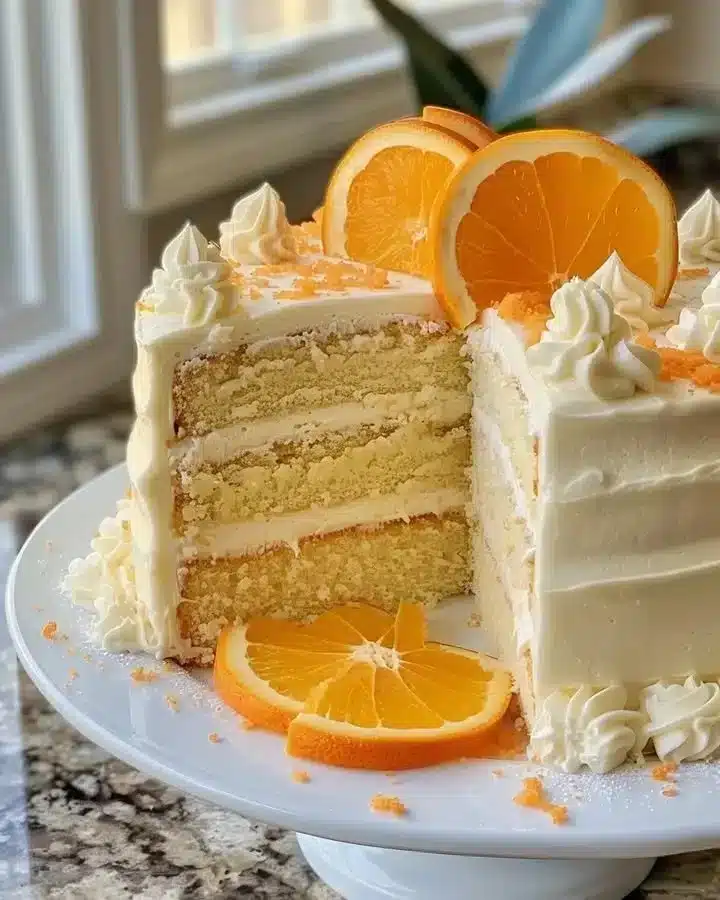
Orange Dreamsicle Cake — Lush Citrus Cream Layer
The first bite is sunny and nostalgic: a soft orange sponge with a pillowy vanilla cream that tastes like a grown-up Dreamsicle. Orange Dreamsicle Cake brings bright citrus and sweet vanilla together in a light layer cake that’s still simple to make at home. After testing this recipe 8 times with different orange varieties and butter ratios, I settled on a tender crumb and a silky vanilla frosting that hold up well between slices. I developed and perfected this version while refining citrus cakes at my bakery; it’s the one I send to friends when I want a guaranteed smile. Read on for the exact steps, pro tips, and storage advice so you can make a perfect, sliceable cake.
Why This Recipe Works
- Balanced acidity: fresh orange juice and zest brighten the cake without making it wet or gummy.
- Tender crumb: the combination of oil and buttermilk keeps the cake moist and soft.
- Stable frosting: a butter-and-cream-cheese vanilla frosting holds shape while tasting clean and creamy.
- Simple emulsification: whisking wet ingredients thoroughly before folding in flour prevents overmixing and keeps the cake light.
- Tested swaps: I adjusted sugar and oven time across trials to avoid dry slices and underbaked centers.
Ingredients Breakdown
- All-purpose flour — 300 g (2 1/2 cups). Provides structure. Spoon and level for accuracy. For a slightly lighter crumb, you can replace 50 g (1/3 cup + 1 tbsp) with cake flour.
- Baking powder — 10 g (2 tsp) and baking soda — 3 g (1/2 tsp). Leaveners for lift; ensure freshness.
- Kosher salt — 6 g (1 tsp) (Diamond Crystal). If using Morton’s, use 3/4 tsp because it’s denser.
- Granulated sugar — 400 g (2 cups). Sweetness and tenderness.
- Large eggs — 4 eggs, room temperature. Eggs give structure and help emulsify the batter. If you must swap for egg replacer, expect a denser crumb.
- Vegetable oil — 120 ml (1/2 cup). Keeps the cake moist better than butter alone.
- Unsalted butter — 85 g (6 tbsp), melted and cooled. Adds flavor and richness.
- Buttermilk — 240 ml (1 cup). Adds acidity and tenderness. If you don’t have buttermilk, mix 240 ml (1 cup) milk with 1 tbsp lemon juice and rest 5 minutes.
- Fresh orange juice — 120 ml (1/2 cup) plus extra for brushing. Fresh juice gives the cleanest citrus flavor; bottled juice will be flatter.
- Orange zest — from 2 large oranges (about 2 tbsp). Zest is concentrated flavor — don’t skip.
- Pure vanilla extract — 10 ml (2 tsp). For the vanilla layer in the frosting.
- Cream cheese — 225 g (8 oz), softened. Adds tang and stability to the frosting.
- Powdered sugar — 480 g (4 cups), sifted. For smooth, lump-free frosting.
- Heavy cream — 60–120 ml (1/4–1/2 cup) to thin the frosting if needed.
Substitutions with impact warnings:
- Greek yogurt for buttermilk: okay, but the cake may be slightly tangier.
- Coconut oil instead of vegetable oil: gives a coconut note. Use refined for a neutral taste.
- Gluten-free flour 1:1 blend: may require 1 tsp xanthan gum and slightly longer bake time.
Essential Equipment
- Two 9-inch (23 cm) round cake pans — the batter volume needs these to bake evenly. Do not use 8-inch pans unless halving the recipe.
- Kitchen scale — for precise flour and sugar measurements.
- Stand mixer or hand mixer — for creaming and whipping the frosting.
- Zester or microplane — for bright orange zest.
- Instant-read thermometer — to check doneness (internal temp around 95–99°C (203–210°F) for sponge cakes if desired).
- Offset spatula and bench scraper — for smooth frosting; a flat knife can work in a pinch.
- Cooling rack and parchment rounds — for even cooling and easy removal.
Step-by-Step Instructions
Prep Time: 25 minutes | Cook Time: 25–30 minutes | Inactive Time: 1 hour (cooling and chilling) | Total Time: about 2 hours | Servings: 12 slices
Step 1: Preheat and prepare pans
Preheat the oven to 175°C (350°F). Grease two 9-inch (23 cm) round pans and line the bottoms with parchment; grease the parchment. This prevents sticking and promotes even browning. Place the pans on the middle rack.
Step 2: Mix dry ingredients
Whisk together 300 g (2 1/2 cups) all-purpose flour, 10 g (2 tsp) baking powder, 3 g (1/2 tsp) baking soda, and 6 g (1 tsp) kosher salt in a bowl for 30 seconds. This distributes leaveners and salt evenly so every bite rises the same.
Step 3: Combine wet ingredients
In a large bowl, whisk 400 g (2 cups) granulated sugar and 4 large eggs for 1–2 minutes until slightly thickened. Add 120 ml (1/2 cup) vegetable oil, 85 g (6 tbsp) melted butter, 240 ml (1 cup) buttermilk, 120 ml (1/2 cup) fresh orange juice, zest from 2 oranges (about 2 tbsp), and 10 ml (2 tsp) vanilla. Whisk until the mixture is smooth and homogenous — about 30–45 seconds.
Step 4: Fold dry into wet
Add the dry ingredients to the wet in two additions. Fold gently with a spatula until just combined — do not overmix. A few streaks of flour are okay; finish stirring for no more than 10–15 strokes. Overmixing makes the cake tough.
Step 5: Bake the layers
Divide the batter evenly between the prepared pans. Smooth the tops and bake at 175°C (350°F) for 25–30 minutes, rotating the pans at 18 minutes if your oven runs hot. Bake until a toothpick comes out with a few moist crumbs or the center springs back to touch.
Step 6: Cool and brush with juice
Let cakes cool in the pans for 10 minutes, then run a knife around the edges and invert onto cooling racks. While still warm, brush each layer lightly with 30–45 ml (2–3 tbsp) fresh orange juice to add moisture and flavor. Cool completely, about 1 hour.
Step 7: Make the vanilla cream frosting
Beat 225 g (8 oz) softened cream cheese with 115 g (8 tbsp) unsalted butter until smooth, about 2 minutes. Add 480 g (4 cups) sifted powdered sugar gradually and 10 ml (2 tsp) vanilla. Add 60–120 ml (1/4–1/2 cup) heavy cream to reach a spreadable consistency. Chill 10 minutes if too soft.
Step 8: Assemble and chill
Place one layer on a cake board and spread 1/3 of the frosting. Top with the second layer, crumb-coat with a thin layer of frosting, chill 15 minutes, then finish frosting smooth. Chill the assembled cake at least 30 minutes before slicing to set the frosting for clean cuts.
Expert Tips & Pro Techniques
- Use room-temperature eggs and buttermilk: they emulsify better and trap air, creating a lighter crumb.
- Avoid overbaking: test at 20 minutes and then every 3 minutes; a dry cake is the most common failure.
- For even layers: weigh the batter into each pan to ensure identical amounts.
- Make-ahead: you can bake the layers 2 days ahead, wrap them tightly, and store in the fridge. Bring to room temperature before frosting.
- Professional trick at home: freeze the layers 15 minutes before frosting to reduce crumbs and make a smoother finish.
- Common mistake: adding too much orange juice to the batter. Stick to the measured amount; extra liquid ruins structure.
Storage & Reheating
- Refrigerator: Store the frosted cake in an airtight cake carrier or covered with plastic wrap for up to 4 days.
- Freezer: The unfrosted layers freeze well for up to 3 months. Wrap each layer tightly in plastic and foil. Thaw in the fridge overnight, then bring to room temperature before frosting.
- Reheating: Slices are best at room temperature. If you want warm slices, heat single portions in a 175°C (350°F) oven for 6–8 minutes. Avoid microwaving frosted slices — it melts the frosting and makes texture gummy.
Variations & Substitutions
- Gluten-Free Version: Use a 1:1 GF flour blend (such as Bob’s Red Mill) and add 1 tsp xanthan gum. Baking time may increase by 3–5 minutes.
- Lighter Frosting: Swap half the cream cheese for whipped mascarpone for a silkier taste; keep the powdered sugar amount the same.
- Dairy-Free Version: Replace butter with dairy-free margarine, cream cheese with a plant-based version, and buttermilk with soy milk + 1 tbsp lemon juice. Texture will be slightly different.
- Intensified Orange: Fold 1 tbsp of orange marmalade into the frosting between layers for a glossy citrus ribbon; no change to bake time.
- Single-Layer Sheet Cake: Pour batter into a greased 9×13-inch (23×33 cm) pan and bake at 175°C (350°F) for 25–30 minutes; check doneness earlier.
Serving Suggestions & Pairings
- Serve with lightly whipped cream and a sprinkle of fresh orange zest.
- Pair with an Earl Grey tea or a light Prosecco to balance the sweetness.
- For a fruit contrast, serve with macerated berries or a simple raspberry coulis.
- Try alongside our almond pound cake for a party dessert table: almond pound cake.
Nutrition Information
Per serving (1 slice — recipe makes 12 slices):
- Calories: 430 kcal
- Total Fat: 22 g
- Saturated Fat: 11 g
- Cholesterol: 95 mg
- Sodium: 240 mg
- Total Carbohydrates: 56 g
- Dietary Fiber: 1.2 g
- Sugars: 36 g
- Protein: 4.8 g
Nutrition values are estimates. Actual values may vary based on specific ingredients and preparation methods.
Frequently Asked Questions
Q: Why did my cake turn out dry?
A: Most often you baked it too long or overmixed the batter. Check for doneness earlier and stop mixing when flour streaks disappear.
Q: Can I make this without eggs?
A: You can use 4 egg replacer equivalents, but expect a denser crumb and slightly different structure.
Q: Can I double this recipe for a larger party?
A: Yes. Bake in multiple pans or use deeper pans; increase bake time by 5–10 minutes and test for doneness.
Q: Can I prepare this the night before?
A: Yes. Bake the layers and cool completely, then wrap and refrigerate. Assemble and chill the next day for best flavor.
Q: How long does this keep in the fridge?
A: The frosted cake keeps for up to 4 days in the refrigerator when stored airtight.
Q: Can I use bottled orange juice instead of fresh?
A: You can, but fresh juice and zest provide brighter, cleaner citrus notes. Bottled juice may taste flatter.
Q: Why is the frosting too soft?
A: Either the room is warm or the frosting needs more chill. Place the frosting in the fridge for 10–15 minutes, or add 1–2 tbsp more powdered sugar to firm it.
Conclusion
This Orange Dreamsicle Cake is a bright, crowd-pleasing dessert that brings retro flavor into a modern, stable format. For another citrus-forward option, see the vibrant combinations in our lemon and pistachio cake round-up at lemon drizzle cake with pistachio and blood orange. If you want an alternative take with chocolate and orange, try the chocolate-orange marble technique shown in chocolate-orange marble cake. For additional inspiration and similar recipes, these two recipes also explore the Dreamsicle theme: Orange Dreamsicle Cake – Delicious Homemade Recipe and orange dreamsicle cake – Blue Bowl Recipes.
Print
Orange Dreamsicle Cake
- Total Time: 120 minutes
- Yield: 12 servings 1x
- Diet: Vegetarian
Description
A soft orange sponge cake layered with a creamy vanilla frosting, reminiscent of a Dreamsicle, perfect for brightening any occasion.
Ingredients
- 300 g (2 1/2 cups) all-purpose flour
- 10 g (2 tsp) baking powder
- 3 g (1/2 tsp) baking soda
- 6 g (1 tsp) kosher salt
- 400 g (2 cups) granulated sugar
- 4 large eggs, room temperature
- 120 ml (1/2 cup) vegetable oil
- 85 g (6 tbsp) unsalted butter, melted and cooled
- 240 ml (1 cup) buttermilk
- 120 ml (1/2 cup) fresh orange juice
- Zest from 2 large oranges (about 2 tbsp)
- 10 ml (2 tsp) pure vanilla extract
- 225 g (8 oz) cream cheese, softened
- 480 g (4 cups) powdered sugar, sifted
- 60–120 ml (1/4–1/2 cup) heavy cream
Instructions
- Preheat the oven to 175°C (350°F). Grease two 9-inch round cake pans and line with parchment paper.
- Whisk together the flour, baking powder, baking soda, and salt in a bowl.
- In a large bowl, whisk the sugar and eggs until thickened. Add in the oil, melted butter, buttermilk, orange juice, zest, and vanilla, whisking until smooth.
- Fold the dry ingredients into the wet until just combined; do not overmix.
- Divide batter between prepared pans and bake for 25–30 minutes, rotating at 18 minutes.
- Cool the cakes for 10 minutes in pans, then brush with fresh orange juice and cool completely on racks.
- For frosting, beat together cream cheese and butter until smooth. Gradually add powdered sugar and vanilla, then heavy cream until spreadable.
- Assemble the cake by layering with frosting and chilling to set.
Notes
Use room-temperature ingredients for better emulsification. Store leftovers in an airtight container for up to 4 days.
- Prep Time: 25 minutes
- Cook Time: 30 minutes
- Category: Dessert
- Method: Baking
- Cuisine: American
Nutrition
- Serving Size: 1 slice
- Calories: 430
- Sugar: 36g
- Sodium: 240mg
- Fat: 22g
- Saturated Fat: 11g
- Unsaturated Fat: 8g
- Trans Fat: 0g
- Carbohydrates: 56g
- Fiber: 1.2g
- Protein: 4.8g
- Cholesterol: 95mg

Written by Chef Anna
I'm Anna - a Le Cordon Bleu-trained chef, recipe developer, and the voice behind Chef Johns Gourmet. After a decade in professional kitchens, I now spend my mornings testing recipes and my afternoons writing them down so you can make them perfectly in your own kitchen. Every one of the 1,100+ recipes on this site has been personally cooked, tasted, and refined. I write like I'm standing next to you, walking you through every step. Simple recipes. Bold flavors. Made for real kitchens.