
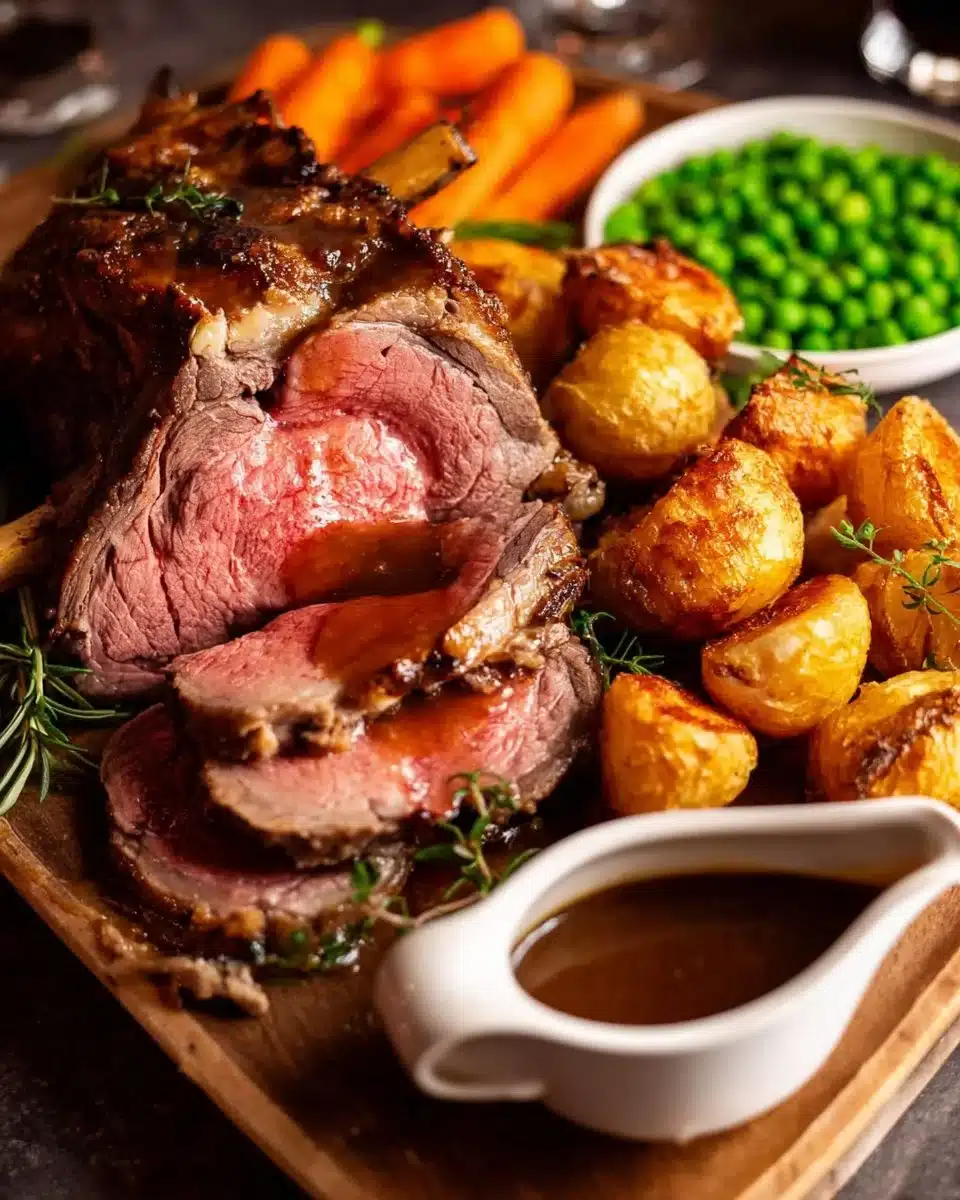
Roast Lamb Leg with Gravy
The oven fills the kitchen with savory smoke and rosemary — this roast lamb leg with gravy yields a deeply flavored crust and tender pink meat. I developed this method over eight test roasts to balance searing, slow roasting, and a pan-juice gravy that never tastes thin. The technique is straightforward but precise: dry the skin, brown well, roast at moderate heat, then rest before carving so juices redistribute. This is the version I refined while running a bistro kitchen, and it’s built for home cooks who want restaurant results without fuss. Read on for clear timing, exact temperatures, and a fail-safe gravy — plus quick side ideas and tips for making this ahead for guests. If you love classic roasts, you might also enjoy our Christmas roast duck recipe for holiday menus.
Why this recipe works
- Slow carryover resting keeps the lamb juicy while finishing to the ideal internal temperature.
- High-heat sear before roasting creates a browned crust that locks flavor and produces rich fond for gravy.
- A simple pan-juice gravy (deglazed with wine or stock) concentrates flavor without added thickeners.
- Fresh rosemary and garlic pair with lamb’s natural richness; citrus zest brightens the sauce at the end.
- Resting and carving against the grain produces tender slices that hold their juices.
Ingredients breakdown
- 2 kg (4 lb 8 oz) bone-in leg of lamb — Bone adds flavor and conducts heat more evenly. You can use boneless (2 kg boneless) but reduce resting time by 5–10 minutes.
- 2 tbsp (30 ml) olive oil — For searing and helping the herb rub stick. Use extra-virgin for flavor.
- 2 tsp (10 g) Diamond Crystal kosher salt (or 1¼ tsp Morton) — Salt seasons the meat surface; if using Morton’s, halve the amount due to density differences.
- 1½ tsp (3 g) freshly ground black pepper — Freshly cracked for best aroma.
- 6 garlic cloves, minced (about 18 g) — Garlic flavors the crust and the gravy. Roasted whole cloves can be stirred into gravy for a sweeter note.
- 4 sprigs fresh rosemary, leaves chopped (about 2 tbsp / 8 g) — Rosemary is classic with lamb; dried rosemary will be more intense so use 1 tsp if substituting.
- 4 sprigs fresh thyme, leaves stripped (about 2 tsp / 4 g) — Adds a floral, savory lift.
- Zest of 1 lemon — Optional; brightens the gravy at the end.
- 2 tbsp (30 g) unsalted butter — For finishing the gravy for sheen and flavor.
- 2 tbsp (16 g) all-purpose flour — To thicken the gravy slightly; for gluten-free use a cornstarch slurry (1 tbsp cornstarch + 2 tbsp cold water).
- 120 ml (½ cup) dry red wine — Optional; deglazes the pan and adds depth. Use beef stock if avoiding alcohol.
- 480 ml (2 cups) lamb or beef stock — The body of the gravy; homemade or low-sodium store-bought.
- 1 tsp (5 ml) balsamic vinegar or 1 tbsp (15 ml) lemon juice — Brightens the gravy at the end.
- Fresh parsley, chopped, for garnish — Optional.
Substitutions with impact warnings:
- You can replace red wine with extra stock, but the gravy will be lighter in body.
- Swap butter for olive oil to keep it dairy-free; the gravy will be less glossy.
- If you choose boneless lamb, expect a slightly faster cook and a sweeter texture.
Essential equipment
- Roasting pan with a rack — Keeps the lamb out of its juices for even browning. If you don’t have a rack, use a bed of halved onions and carrots to lift the roast.
- Instant-read digital thermometer — Critical for perfect doneness. Aim for 58–60°C (136–140°F) for medium-rare after resting.
- Large skillet (heavy-bottomed) — For searing if your oven-safe pan is not flat enough.
- Fine-mesh strainer — To remove solids for a silky gravy.
- Heatproof spoon and whisk — For deglazing and finishing the gravy.
- Carving knife and fork — A sharp carving knife makes clean slices.
- Meat thermometer probe with alarm (optional) — Useful for unattended roasting.
You can use the same skillet recommended for pan sauces when cooking delicate seafood such as elegant scallops with vodka, so choose one that handles high heat.
This recipe serves 6, prep about 20 minutes active, cook 1 hour 45 minutes active, rest 15 minutes inactive, total roughly 2 hours 20 minutes.
Step 1: Bring the lamb to room temperature and season
Remove the leg from the fridge 45–60 minutes before cooking so it comes closer to room temperature. Pat dry with paper towels and rub all over with 2 tbsp (30 ml) olive oil, 2 tsp (10 g) salt, 1½ tsp (3 g) pepper, the minced garlic, chopped rosemary, thyme, and lemon zest. Let sit while you preheat the oven. (Time: 45–60 minutes; sensory cue: surface should no longer feel cold.)
Step 2: Preheat and sear for color
Heat the oven to 200°C (400°F). Place a heavy roasting pan or skillet over high heat. Sear the lamb on all sides, about 2 minutes per side, until a deep golden crust forms and the pan has a dark fond — this adds flavor for the gravy. Transfer leg to a rack in the roasting pan. (Time: 8–10 minutes; cue: crust is deeply browned, not burnt.)
Step 3: Roast at steady heat
Insert an instant-read thermometer into the thickest part, avoiding bone. Roast at 180°C (350°F) for 50–70 minutes (depending on leg size) until the thermometer reads 52–54°C (125–130°F) for rare, 58–60°C (136–140°F) for medium-rare, or 63–65°C (145–149°F) for medium. Do not rely on clock time only — use internal temperature. (Time: 50–70 minutes; cue: thermometer reading noted above.)
Step 4: Rest the meat
Remove the lamb and tent loosely with foil. Let rest on a board for 15–20 minutes — this is your inactive time so juices redistribute and the roast finishes with carryover heat reaching your target. Reserve pan juices and fat for the gravy. (Time: 15–20 minutes; cue: lamb stops steaming and feels firm but yielding.)
Step 5: Make the pan-juice gravy
Pour off excess fat, keeping brown bits (fond) in the pan. Place pan on medium heat, add 120 ml (½ cup) red wine and scrape up the fond. Simmer until reduced slightly, 2–3 minutes. Stir in 2 tbsp (16 g) flour and cook 1 minute. Whisk in 480 ml (2 cups) stock gradually, simmer 5–7 minutes until thickened and glossy. Stir in 2 tbsp (30 g) butter off heat and 1 tsp (5 ml) balsamic or 1 tbsp (15 ml) lemon juice. Strain into a gravy boat and taste for seasoning. (Time: 10–12 minutes; cue: gravy coats the back of a spoon and glistens.)
Step 6: Carve and serve
Carve against the grain in thin slices, arranging on a warmed platter. Spoon gravy over the slices or serve on the side. Garnish with chopped parsley. (Time: 5–10 minutes; cue: slices are tender and juicy with a rosy center if cooked to medium-rare.)
Expert Tips & Pro Techniques
- Resting is critical: skipping it makes the roast lose more juices when carved. Always rest 15–20 minutes.
- Common mistake: overcooking. Use an instant-read thermometer and remove the roast 3–5°C (5–9°F) below target to allow for carryover.
- Make-ahead: Roast the lamb a day ahead, carve, and store slices in a shallow airtight container with reserved gravy. Reheat gently in a 150°C (300°F) oven for 10–15 minutes with gravy added to keep moisture.
- Professional technique adapted for home: Sear in a very hot pan rather than relying on oven browning alone — it creates a deeper fond for the gravy without drying the interior.
- For extra-flavor gravy: after deglazing, add pan-roasted shallots or a few whole roasted garlic cloves mashed into the sauce.
- Texture trick: If gravy is too thin, whisk a cornstarch slurry (1 tsp cornstarch + 1 tsp cold water) and stir in a little at a time; do not boil vigorously or it will thin again.
Storage & Reheating
- Refrigerator: Store carved lamb and gravy in separate airtight containers for up to 4 days. Place gravy in a shallow container to cool quickly.
- Freezer: Cooked lamb freezes well for up to 3 months. Wrap tightly in plastic and foil or use vacuum sealing. Freeze gravy in a freezer-safe container for up to 3 months; leave some headspace.
- Thawing: Thaw overnight in the fridge.
- Reheating: Reheat covered in a 175°C (350°F) oven for 10–15 minutes until warmed through. Warm gravy gently on the stove over low heat. Avoid microwave reheating of full slices; it can make the texture stringy.
Variations & Substitutions
- Herb-Crusted with Dijon: Add 2 tbsp (30 g) Dijon mustard before applying the herb rub; press ½ cup (50 g) panko mixed with 2 tbsp (8 g) grated parmesan onto the mustard. Roast time unchanged.
- Garlic-Lemon Roast (lighter): Double the lemon zest and add 2 tbsp (30 ml) lemon juice to the gravy at the end; omit red wine. Gravy will be brighter, slightly less rich.
- Gluten-Free Gravy: Use 1 tbsp (8 g) cornstarch mixed with 2 tbsp (30 ml) cold water instead of flour; add after deglazing and simmer until glossy.
- Slow-Roast, Low-Temp Option: Roast at 140°C (285°F) for 2½–3 hours to 55–58°C (131–136°F), then blast at 220°C (430°F) for 8–10 minutes for crust. Total time increases; flavor concentrates.
- Boneless leg: Use the same seasonings but reduce roast time by 10–15 minutes and watch temperature closely. Rest for 10–15 minutes.
For a roasted vegetable side, try this asiago roasted garlic cauliflower as a cheesy, crisp complement.
Serving suggestions & pairings
- Classic: Roast potatoes, buttered green beans, and tangy gravy.
- Fresh contrast: A crisp salad with citrus vinaigrette, such as an Aussie prawn salad, for a lighter counterpoint.
- Bread: Warm crusty bread or dinner rolls to mop up gravy.
- Beverage: Full-bodied red wine like Cabernet Sauvignon or a robust Rioja. For a non-alcoholic option, serve a sparkling water with lemon.
Nutrition information
Per serving (serving size: about 200 g cooked lamb slices with 2 tbsp gravy; recipe yields 6 servings):
- Calories: 620 kcal
- Total Fat: 42 g
- Saturated Fat: 15 g
- Cholesterol: 190 mg
- Sodium: 780 mg
- Total Carbohydrates: 6 g
- Dietary Fiber: 0.5 g
- Sugars: 1 g
- Protein: 48 g
Nutrition values are estimates. Actual values may vary based on specific ingredients and preparation methods.
Frequently Asked Questions
Q: Why did my roast lamb leg turn out dry?
A: Most often it was overcooked. Use an instant-read thermometer and remove the roast 3–5°C (5–9°F) below your target to allow for carryover. Also let the meat rest 15–20 minutes before carving.
Q: Can I make this without wine?
A: Yes. Substitute equal parts low-sodium beef or lamb stock for the wine when deglazing. The gravy will be slightly less complex but still flavorful.
Q: Can I double this recipe for a larger gathering?
A: Yes. Roast each leg separately if possible so air circulates evenly. If both fit in the oven, increase roasting time slightly and rely on internal temperature rather than clock time.
Q: Can I prepare this the night before?
A: Absolutely. Roast, carve, and refrigerate. Reheat gently in a 150°C (300°F) oven with a splash of reserved gravy for 10–15 minutes. Make the gravy fresh or reheat the cooled gravy on the stove.
Q: How long does this keep in the fridge?
A: Cooked lamb and homemade gravy will keep in the refrigerator for up to 4 days in airtight containers.
Q: Is bone-in better than boneless?
A: Bone-in often delivers more flavor and slightly juicier meat due to heat conduction. Boneless is easier to carve and may cook faster.
Q: What internal temperature should I aim for for medium-rare?
A: Remove from the oven at 58–60°C (136–140°F) for medium-rare after resting; some chefs prefer 52–54°C (125–130°F) for rare. Always use an instant-read thermometer.
Conclusion
This roast method gives reliably juicy slices with a rich, glossy pan-juice gravy. For another take on roast leg techniques, see the detailed RecipeTin Eats roast lamb leg recipe which offers helpful variations and timing notes. If you want a step-by-step guide focused solely on turning pan juices into silky gravy, this tutorial on how to make roast lamb gravy from pan juices is a great companion.
Print
Roast Lamb Leg with Gravy
- Total Time: 125 minutes
- Yield: 6 servings 1x
- Diet: None
Description
A perfectly roasted leg of lamb with a savory gravy, ideal for festive occasions and hearty meals.
Ingredients
- 2 kg (4 lb 8 oz) bone-in leg of lamb
- 2 tbsp (30 ml) olive oil
- 2 tsp (10 g) Diamond Crystal kosher salt
- 1½ tsp (3 g) freshly ground black pepper
- 6 garlic cloves, minced (about 18 g)
- 4 sprigs fresh rosemary, leaves chopped (about 2 tbsp / 8 g)
- 4 sprigs fresh thyme, leaves stripped (about 2 tsp / 4 g)
- Zest of 1 lemon (optional)
- 2 tbsp (30 g) unsalted butter
- 2 tbsp (16 g) all-purpose flour
- 120 ml (½ cup) dry red wine (optional)
- 480 ml (2 cups) lamb or beef stock
- 1 tsp (5 ml) balsamic vinegar or 1 tbsp (15 ml) lemon juice
- Fresh parsley, chopped, for garnish (optional)
Instructions
- Bring the lamb to room temperature and season. Remove the leg from the fridge 45–60 minutes before cooking so it comes closer to room temperature. Pat dry with paper towels and rub all over with olive oil, salt, pepper, minced garlic, chopped rosemary, thyme, and lemon zest. Let sit while you preheat the oven.
- Preheat and sear for color. Heat the oven to 200°C (400°F). Sear the lamb on all sides in a heavy roasting pan or skillet over high heat, about 2 minutes per side, until a deep golden crust forms. Transfer leg to a rack in the roasting pan.
- Roast at steady heat. Insert an instant-read thermometer into the thickest part, avoiding bone. Roast at 180°C (350°F) for 50–70 minutes until the thermometer reads 58–60°C (136–140°F) for medium-rare.
- Rest the meat. Remove the lamb and tent loosely with foil. Let rest on a board for 15–20 minutes, allowing juices to redistribute.
- Make the pan-juice gravy. Pour off excess fat from the roasting pan, leaving brown bits. Place the pan on medium heat, add red wine, and scrape up the fond. Simmer until reduced slightly. Stir in flour, then gradually whisk in stock, and simmer until thickened. Stir in butter and balsamic vinegar off heat, then strain into a gravy boat.
- Carve and serve. Carve against the grain in thin slices, arranging on a warmed platter. Spoon gravy over the slices or serve on the side, garnished with parsley.
Notes
Resting is critical for juicy meat. Use an instant-read thermometer for perfect doneness.
- Prep Time: 20 minutes
- Cook Time: 105 minutes
- Category: Main Course
- Method: Roasting
- Cuisine: Mediterranean
Nutrition
- Serving Size: 200 g cooked lamb with 2 tbsp gravy
- Calories: 620
- Sugar: 1 g
- Sodium: 780 mg
- Fat: 42 g
- Saturated Fat: 15 g
- Unsaturated Fat: 20 g
- Trans Fat: 0 g
- Carbohydrates: 6 g
- Fiber: 0.5 g
- Protein: 48 g
- Cholesterol: 190 mg