
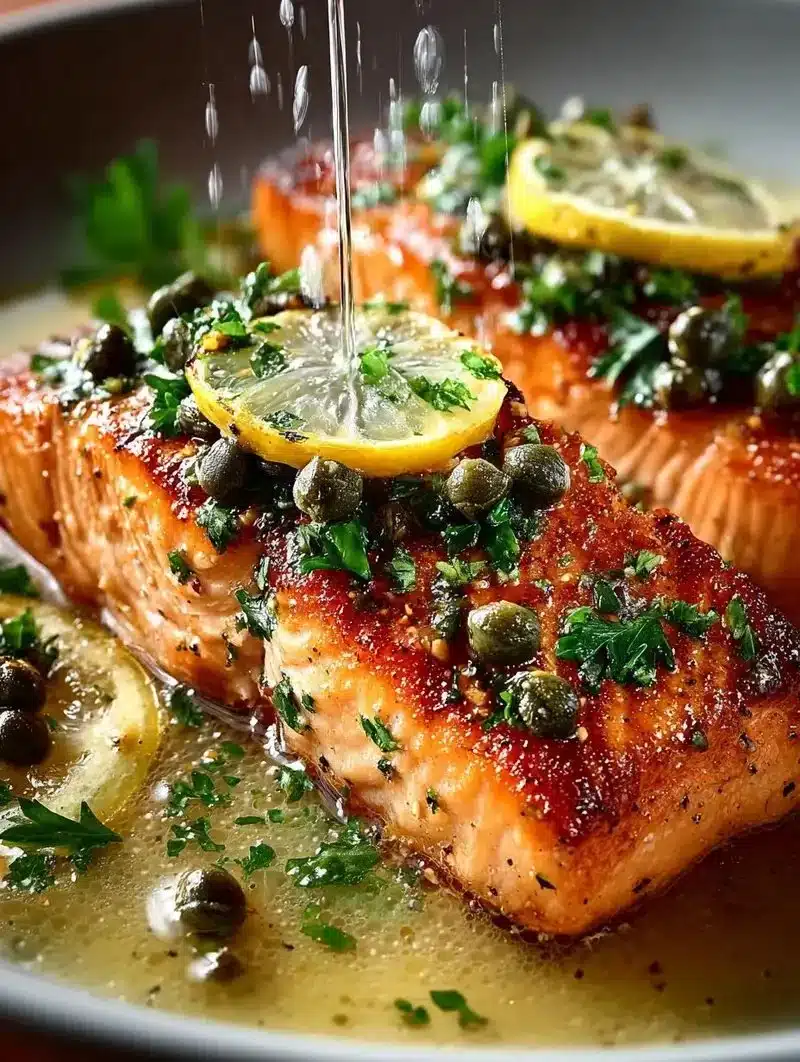
Salmon Piccata: Lemon Caper Skillet
Bright lemon, sizzling butter, and briny capers lift Salmon Piccata to weeknight-star status. After refining this method across many kitchens and testing it on busy weeknights, I landed on a quick pan-sear plus sauce technique that keeps the fish moist and the sauce silky. This is the version I perfected while teaching at a community cooking program — I tested it on home cooks of all levels and adjusted the salt, lemon, and cooking time until it was reliably excellent. You’ll get a crisp-edged fillet, a glossy lemon-caper butter sauce, and a simple method you can repeat. Read on for ingredients, step-by-step timing, and pro tips that keep the salmon tender and the sauce bright.
Why This Recipe Works
- Hot pan, brief cook time: a hot skillet gives a thin brown crust while keeping the interior flaky and moist.
- Flour dredge + butter finish: a light dusting of flour encourages a golden edge and helps thicken the pan sauce.
- Acid balance: lemon brightens; a small splash of stock or wine tempers the acid so the sauce isn’t sharp.
- Butter emulsion: swirling cold butter into the sauce off the heat yields a glossy, smooth finish without breaking.
- Quick technique reduces moisture loss — the whole cook is done in under 20 minutes, so the salmon stays tender.
Ingredients Breakdown
- Salmon fillets: 680 g (24 oz) total — four 170 g (6 oz) fillets, skin-on or skinless. Skin-on helps protect the flesh from overcooking and adds flavor when crisped. If using farmed salmon, lower the heat slightly.
- All-purpose flour: 30 g (1/4 cup) — for a light dredge to promote browning. Gluten-free: use a 1:1 GF blend; texture will be slightly different.
- Kosher salt: 1 1/2 tsp (Diamond Crystal) or 1 tsp (Morton’s) — I recommend Diamond Crystal; it’s lighter, so measure as written.
- Freshly ground black pepper: 1/2 tsp — adjust to taste.
- Extra-virgin olive oil: 2 tbsp (30 ml) — for the sear.
- Unsalted butter: 3 tbsp (45 g) — 2 tbsp for cooking, 1 tbsp cold to finish the sauce. Use unsalted so you control seasoning.
- Shallot: 1 small (30 g), finely minced — adds a mild onion sweetness.
- Dry white wine or low-sodium chicken stock: 60 ml (1/4 cup) — deglazes the pan and builds sauce flavor. Wine gives brightness; stock keeps it alcohol-free.
- Fresh lemon juice: 45 ml (3 tbsp), about 1 large lemon — primary acid.
- Capers, rinsed: 2 tbsp (30 g) — give the signature briny bite. Rinse if extra salty.
- Fresh parsley: 2 tbsp, chopped — for finishing.
- Optional: 1 tsp Dijon mustard for extra body. Use if you like a slightly tangier sauce.
Essential Equipment
- 10–12 inch (25–30 cm) heavy skillet — stainless steel or cast iron works best for even browning. Nonstick can be used but won’t develop fond as well.
- Instant-read thermometer — helps cook salmon to exact doneness.
- Fish spatula or flexible spatula — for turning fillets without tearing.
- Small bowl for dredging flour and seasoning.
- Microplane or fine grater for zesting lemon.
Step-by-Step Instructions
Prep Time 10 minutes, Cook Time 12 minutes, Inactive Time None, Total Time ~22 minutes. Serves 4.
Step 1: Pat and season the salmon
Pat 680 g (24 oz) salmon fillets dry with paper towels and season both sides with 1 1/2 tsp kosher salt and 1/2 tsp black pepper. Let rest at room temperature 5–10 minutes — this helps even cooking. If the fillets are very thick, make a shallow score in the skin-side to prevent curling.
Step 2: Dredge the fillets lightly
Place 30 g (1/4 cup) all-purpose flour in a shallow bowl and dredge each fillet, shaking off excess. This thin coat promotes browning and helps thicken the sauce once the pan is deglazed. Do not over-dust — a light, even layer is enough.
Step 3: Heat the pan and sear the salmon
Heat 2 tbsp (30 ml) olive oil in a 10–12 inch (25–30 cm) skillet over medium-high until shimmering (about 190°C/375°F on cast iron). Add the fillets skin-side down if using skin-on. Sear 3–4 minutes without moving, until edges turn opaque and skin is crisp. Flip and cook 2–4 minutes more, until an instant-read thermometer in the thickest part reads 52–54°C (125–130°F) for medium-rare, or 60–63°C (140–145°F) for well done. Remove salmon to a warm plate and tent loosely with foil.
Step 4: Build the sauce
Lower heat to medium. Add 1 tbsp (15 g) unsalted butter to the same skillet. Sauté 30–45 seconds and add 1 small minced shallot; cook until translucent and fragrant, about 1–2 minutes. Add 60 ml (1/4 cup) dry white wine or stock and scrape up fond for 30–60 seconds, reducing slightly.
Step 5: Finish with lemon, capers, and butter
Stir in 45 ml (3 tbsp) fresh lemon juice and 2 tbsp (30 g) rinsed capers and simmer 30–60 seconds. Remove pan from heat and whisk in 2 tbsp (30 g) cold unsalted butter, one piece at a time, until sauce is glossy. Add 2 tbsp chopped parsley and taste for seasoning; add up to 1/4 tsp salt if needed.
Step 6: Plate and serve
Return salmon to the pan for 20–30 seconds to warm and coat with sauce, or spoon sauce over each fillet on the plate. Serve immediately with lemon wedges. Total active cooking after searing is about 6–8 minutes; the sauce builds in about 3–4 minutes.
Expert Tips & Pro Techniques
- Use an instant-read thermometer. Salmon is done at 52–63°C (125–145°F) depending on your preference — pull earlier for a moister result.
- Avoid overcooking: remove fillets when they still show a translucent band in the center; carryover heat will finish them.
- Common mistake: cooking at too low a heat. If the pan isn’t hot, the fish steams and won’t brown. Preheat the pan until oil shimmers.
- Make-ahead: cook the sauce (through step 5) up to 24 hours ahead. Refrigerate in an airtight container and gently rewarm; add a knob of cold butter off heat to refresh the emulsion before serving.
- Professional trick for home cooks: after searing, finish thicker fillets in a 180°C (350°F) oven for 3–5 minutes to get even doneness without overbrowning.
- If wine isn’t available, use low-sodium chicken stock and add 1/2 tsp Dijon mustard to deepen flavor.
Storage & Reheating
- Refrigerator: Store leftover salmon and sauce together in an airtight container for up to 3 days. Keep at the back of the fridge for best quality.
- Freezer: Salmon texture changes when frozen; not recommended for best results. If needed, freeze sauce (without fish) in a freezer-safe container for up to 3 months. Thaw overnight in the fridge.
- Reheating: Warm gently in a 175°C (350°F) oven for 6–8 minutes covered with foil, or reheat slices in a skillet over low heat for 3–4 minutes. Avoid microwaving — it can make the salmon mealy and the sauce separate.
Variations & Substitutions
- Gluten-Free Version: Replace 30 g (1/4 cup) all-purpose flour with 30 g (1/4 cup) 1:1 gluten-free blend. Texture will be similar. No additional time change.
- Dairy-Free Version: Use olive oil for finishing instead of butter. Omit the cold butter at the end and whisk in 1 tbsp extra-virgin olive oil off the heat for sheen.
- Lighter, No-Wine Version: Use 60 ml (1/4 cup) low-sodium chicken or vegetable stock and add 1/2 tsp Dijon mustard for body. Sauce will be slightly less acidic.
- Capers-replace: If you dislike capers, use 1 tbsp chopped green olives for a milder brine.
- Citrus twist: Substitute half the lemon juice with orange juice for a sweeter finish; reduce to 30 ml (2 tbsp) lemon + 15 ml (1 tbsp) orange.
Serving Suggestions & Pairings
- Vegetables: Serve with garlic-roasted green beans or sautéed spinach for a bright, green plate. Try pairing with our garlic-butter baked salmon recipe for a complementary garlic-citrus side idea.
- Starches: Buttered egg noodles, herbed rice, or small roasted potatoes soak up the sauce nicely.
- Wine & drinks: A crisp Sauvignon Blanc or a dry Riesling balances the lemon and caper flavors.
- Garnish: Finish with extra lemon zest and a few whole capers for visual contrast and flavor.
Nutrition Information
Per serving (1 fillet, yields 4 servings): Serving size: 1 fillet (approx. 170 g / 6 oz)
- Calories: 430 kcal
- Total Fat: 26 g
- Saturated Fat: 9 g
- Cholesterol: 90 mg
- Sodium: 620 mg
- Total Carbohydrates: 4 g
- Dietary Fiber: 0.5 g
- Sugars: 1 g
- Protein: 41 g
Nutrition values are estimates. Actual values may vary based on specific ingredients and preparation methods.
Frequently Asked Questions
Q: Why did my salmon turn out dry?
A: Most likely it was overcooked. Use an instant-read thermometer and remove the fish at 52–54°C (125–130°F) for medium-rare, or 60–63°C (140–145°F) if you prefer it firmer. Carryover heat will raise the temperature a few degrees.
Q: Can I make this without flour?
A: Yes. Skip the 30 g (1/4 cup) flour. The fillet won’t brown as deeply and the sauce will be slightly thinner; add 1/4 tsp cornstarch slurry if you want more body.
Q: Can I double this recipe?
A: Yes. Use a larger skillet or cook in batches so the pan stays hot. Overcrowding cools the pan and prevents proper searing.
Q: Can I prepare this the night before?
A: You can prepare the sauce up to 24 hours ahead and refrigerate. Rewarm gently and whisk in a knob of cold butter off heat. Cook salmon just before serving for best texture.
Q: How long does this keep in the fridge?
A: Store cooked salmon and sauce together in an airtight container for up to 3 days. For longer storage, freeze the sauce only for up to 3 months.
Q: Can I use frozen salmon?
A: Yes, if fully thawed and patted dry. Thaw in the fridge overnight. Pat very dry to ensure a good sear.
Q: My sauce broke when I added the butter. How do I fix it?
A: Remove from heat and whisk in a small splash of warm stock or a teaspoon of Dijon mustard, then slowly whisk in cold butter piece by piece until emulsified.
Conclusion
If you want a quicker spin on the same flavors, try the classic weeknight take in this 15-Minute Salmon Piccata – Simply Recipes, or see an ultra-quick version in this 7-Minute Salmon Piccata Recipe – Allrecipes to compare techniques and timing.
Print
Salmon Piccata: Lemon Caper Skillet
- Total Time: 22 minutes
- Yield: 4 servings 1x
- Diet: Pescatarian
Description
A quick and flavorful Salmon Piccata featuring a lemon-caper butter sauce that transforms this dish into a weeknight favorite.
Ingredients
- 680 g salmon fillets (24 oz) – four 170 g (6 oz) fillets
- 30 g all-purpose flour (1/4 cup)
- 1 1/2 tsp kosher salt
- 1/2 tsp freshly ground black pepper
- 2 tbsp extra-virgin olive oil (30 ml)
- 3 tbsp unsalted butter (45 g)
- 1 small shallot (30 g), finely minced
- 60 ml dry white wine or low-sodium chicken stock (1/4 cup)
- 45 ml fresh lemon juice (3 tbsp), about 1 large lemon
- 2 tbsp capers, rinsed (30 g)
- 2 tbsp fresh parsley, chopped
- Optional: 1 tsp Dijon mustard
Instructions
- Pat the salmon fillets dry with paper towels and season both sides with kosher salt and black pepper. Let rest at room temperature for 5–10 minutes.
- Dredge each fillet in flour, shaking off excess.
- Heat olive oil in a skillet over medium-high until shimmering. Add fillets skin-side down and sear for 3–4 minutes, then flip and cook for an additional 2–4 minutes until cooked to your preference.
- Remove salmon and tent with foil. In the same skillet, lower heat, add unsalted butter, and sauté. Add shallot and cook until translucent.
- Deglaze the pan with wine or stock, scraping up fond, then add lemon juice and capers, simmering briefly.
- Whisk in cold butter until sauce is glossy. Add parsley and adjust seasoning if necessary.
- Add salmon back to skillet to warm and coat with sauce before serving.
Notes
For extra flavor, consider adding a splash of Dijon mustard to the sauce.
- Prep Time: 10 minutes
- Cook Time: 12 minutes
- Category: Main Course
- Method: Pan-searing
- Cuisine: Italian
Nutrition
- Serving Size: 1 fillet
- Calories: 430
- Sugar: 1g
- Sodium: 620mg
- Fat: 26g
- Saturated Fat: 9g
- Unsaturated Fat: 15g
- Trans Fat: 0g
- Carbohydrates: 4g
- Fiber: 0.5g
- Protein: 41g
- Cholesterol: 90mg

Written by Chef Anna
I'm Anna - a Le Cordon Bleu-trained chef, recipe developer, and the voice behind Chef Johns Gourmet. After a decade in professional kitchens, I now spend my mornings testing recipes and my afternoons writing them down so you can make them perfectly in your own kitchen. Every one of the 1,100+ recipes on this site has been personally cooked, tasted, and refined. I write like I'm standing next to you, walking you through every step. Simple recipes. Bold flavors. Made for real kitchens.