
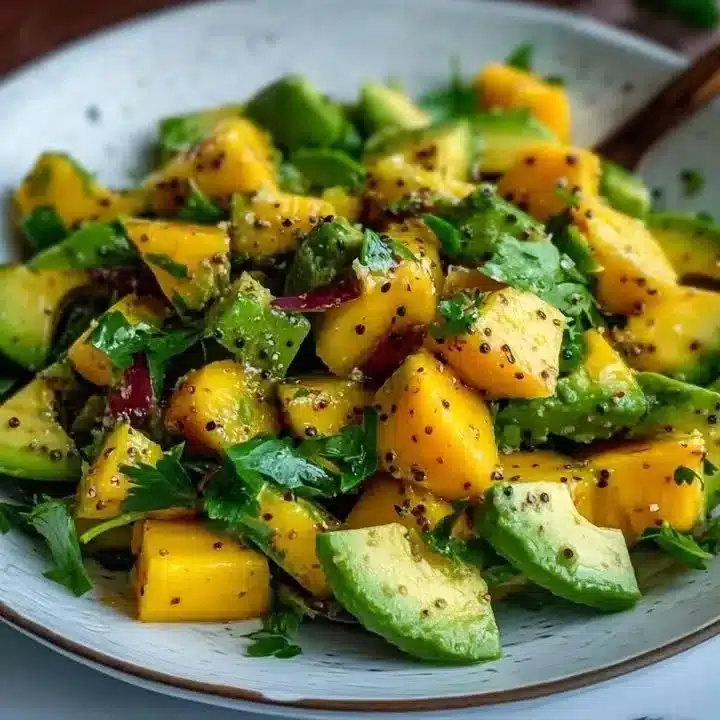
Key Takeaways
- Ready in 15 minutes: No cooking required, just chop, whisk, toss, and serve.
- Perfect sweet-savory balance: Creamy avocado + juicy mango + zesty lime + fresh herbs.
- Naturally healthy: Rich in fiber, potassium, vitamin C, and heart-healthy fats.
- Highly adaptable: Works as salad, taco topper, fish side, or grain bowl base.
- Great for hot weather: Light, hydrating, and refreshing without feeling boring.
Why Avocado Mango Salad Is a Modern Classic
Avocado mango salad became a staple in modern home cooking because it solves a real everyday problem: people want meals that feel fresh, exciting, and healthy without heavy prep, long cooking, or complicated ingredients. This salad delivers all three. The creamy texture of ripe avocado contrasts with the juicy sweetness of mango, while lime juice and herbs keep every bite bright and clean. The result feels restaurant-level but takes less than 15 minutes with basic knife skills.
It also fits multiple eating patterns naturally: vegetarian, gluten-free, dairy-free, and often vegan depending on optional additions. Because it has both satisfying fats (avocado) and fruit-forward freshness (mango), it works as a side dish, a light lunch, or a topping for proteins like salmon, chicken, shrimp, or tofu. Few salads are this versatile while remaining this simple.
Flavor Profile Breakdown
| Ingredient | Primary Flavor | Texture Role | Why It Matters |
|---|---|---|---|
| Avocado | Buttery, mild | Creamy body | Rounds sharp acidity and binds ingredients |
| Mango | Sweet, floral | Juicy pop | Adds contrast and tropical lift |
| Red onion | Pungent, sharp | Crisp bite | Cuts richness and adds structure |
| Lime juice | Acidic, bright | Liquid dressing base | Prevents flat flavor and avocado oxidation |
| Cilantro | Fresh, herbal | Light leafy texture | Completes the tropical profile |
| Olive oil | Fruity, smooth | Emulsion support | Carries flavor and improves mouthfeel |
| Salt | Savory enhancer | N/A | Unlocks sweetness and balances acidity |
| Chili flakes | Warm heat | Micro texture spark | Adds dimension without overpowering |
Ingredient Guide and Substitutions
| Ingredient | Amount | Best Substitute | Notes |
|---|---|---|---|
| Ripe avocados | 2 large | None ideal | Use just-ripe, not mushy |
| Ripe mango | 1 large | Peach, pineapple | Choose fragrant and slightly soft |
| Red onion | 1/4 cup diced | Shallot | Soak in cold water for milder bite |
| Fresh cilantro | 1/3 cup chopped | Parsley | Cilantro gives best profile |
| Lime juice | 3 tbsp | Lemon juice | Freshly squeezed only |
| Lime zest | 1 tsp | Skip | Adds aromatic depth |
| Olive oil | 2 tbsp | Avocado oil | Optional but recommended |
| Salt + pepper | To taste | N/A | Season gradually |
| Chili flakes | 1/4 tsp | Jalapeno, serrano | Adjust heat to preference |
| Cucumber (optional) | 1/2 cup diced | Celery | Adds crunch and hydration |
How to Pick Perfect Avocados and Mangoes
Great salad starts at produce selection. Avocados should yield slightly to gentle pressure near the stem but should not feel mushy or hollow. If the stem nub pops off and reveals green flesh underneath, ripeness is usually ideal. If the flesh is brown under the stem, it’s likely overripe. For mangoes, rely on smell and feel over color. A ripe mango smells sweet near the stem and gives slightly when pressed.
If your avocados are firm, let them ripen in a paper bag with a banana for 24-48 hours. If mango is under-ripe, leave at room temperature and avoid refrigeration until ripe. Once ripe, both can be refrigerated to slow ripening by 1-2 days. This timing control is key if preparing salad for events.
Step-by-Step Method
Dice avocado into medium cubes and mango into similar size so bites stay balanced. Finely dice red onion and chop cilantro. In a small bowl, whisk lime juice, lime zest, olive oil, salt, pepper, and chili flakes until combined. This is your quick dressing.
Place mango, onion, and cilantro in a mixing bowl first and toss with half the dressing. This allows acid and salt to penetrate firmer ingredients. Add avocado last and fold gently with a silicone spatula to avoid mashing. Drizzle remaining dressing over top and fold once or twice only.
Taste and adjust seasoning. If too sweet, add more lime and a pinch of salt. If too sharp, add a tiny drizzle of olive oil. Serve immediately for best texture, or chill 10 minutes for a colder, tighter flavor profile.
Best Serving Ideas
| Use Case | How to Serve | Portion |
|---|---|---|
| Light lunch | Add chickpeas and seeds | 2 cups |
| Fish pairing | Serve with grilled salmon | 3/4 cup side |
| Taco topper | Spoon over shrimp tacos | 2 tbsp each |
| Grain bowl | Add to quinoa + protein | 1 cup |
| Party dip | Serve with tortilla chips | 1 bowl center |
| BBQ side | Pair with chicken skewers | 1/2 cup side |
| Brunch plate | With eggs and toast | 3/4 cup |
| Wrap filler | With greens and feta | 1/2 cup |
5 Variations to Try
1. Tropical Crunch: Add cucumber and toasted coconut flakes for extra freshness and texture.
2. Protein Bowl Version: Add black beans and grilled chicken for a complete high-protein meal.
3. Spicy Street Style: Add diced jalapeno, tajin, and extra lime for Mexican-style heat and tang.
4. Mediterranean Twist: Add feta crumbles, mint, and a little red wine vinegar for a hybrid profile.
5. Discover-Friendly Rainbow: Add red bell pepper and purple cabbage for color-rich presentation and visual CTR.
Equipment Recommendations
| Tool | Why It Helps | Budget Pick |
|---|---|---|
| Chef knife | Clean fruit cubes | Victorinox 8-inch |
| Cutting board | Safe prep area | Bamboo medium board |
| Citrus juicer | Max lime extraction | OXO handheld |
| Mixing bowls | Layered tossing | Stainless set |
| Silicone spatula | Gentle folding | Mini flexible spatula |
| Microplane | Fine lime zest | Classic zester |
| Airtight container | Short-term storage | Glass snap-lid |
Troubleshooting Guide
| Issue | Likely Cause | Fix |
|---|---|---|
| Mushy salad | Overripe avocado or overmixing | Use firmer fruit, fold gently |
| Too sour | Excess lime | Add more mango + olive oil |
| Too sweet | Very ripe mango | Add salt, lime, onion |
| Bitter taste | White pith in zest | Zest only green outer layer |
| Watery bowl | Mango over-juicy | Drain diced mango briefly |
| Flat flavor | Underseasoned | Add salt in small pinches |
| Brown avocado | Oxidation | Dress early with lime, serve fast |
| Harsh onion bite | Raw onion intensity | Soak in cold water 10 min |
Storage and Make-Ahead Strategy
This salad is best fresh, but you can prep smartly. Dice mango, onion, and herbs ahead and refrigerate separately up to 24 hours. Make dressing in advance and store in a jar. Cut avocado right before serving, then combine everything and toss gently. This gives near-fresh quality with event-friendly convenience.
If already mixed, store in airtight container with plastic wrap touching the surface to reduce oxidation. Expect best quality within 12 hours and acceptable quality up to 24 hours. For meal prep, consider adding avocado at the last moment.
Pairings and Internal Recipe Cluster
Avocado mango salad pairs beautifully with copycat salmon, sheet pan shrimp fajitas, slow cooker chicken shawarma, honey garlic chicken breast, garlic parmesan chicken skillet, balsamic baked chicken breast, cottage cheese wraps, strawberry peach smoothie, peanut butter coffee smoothie, and classic lemon bars.
Nutritional Benefits by Ingredient
| Ingredient | Top Nutrients | Main Health Role |
|---|---|---|
| Avocado | Monounsaturated fat, potassium, fiber | Heart support and satiety |
| Mango | Vitamin C, vitamin A, antioxidants | Immunity and skin support |
| Lime | Vitamin C, flavonoids | Antioxidant + mineral absorption |
| Red onion | Quercetin, sulfur compounds | Anti-inflammatory support |
| Cilantro | Vitamin K, aromatic oils | Freshness and micronutrient boost |
| Olive oil | Oleic acid, polyphenols | Flavor delivery + cardiometabolic support |
| Chili | Capsaicin | Flavor stimulation, thermogenic effect |
| Salt (properly used) | Sodium | Flavor activation and balance |
Knife Skills That Improve Texture and UX
Texture consistency is the difference between an average bowl and a premium-feeling salad. Keep avocado and mango dice similar in size so every spoonful is balanced. If mango chunks are too large, sweetness dominates randomly. If avocado is too small, it smears and turns the bowl into mash. Aim for medium cubes around 1.5 cm.
For red onion, ultra-fine dice is best. Large onion chunks can overwhelm delicate tropical notes. After dicing, rinse or soak in cold water for 10 minutes to remove harsh sulfur intensity. Dry before adding so you do not dilute dressing. This one step dramatically improves crowd acceptance, especially for guests sensitive to raw onion bite.
Use a sharp knife and clean board between avocado and herbs. Bruised cilantro or crushed avocado leaks moisture early and shortens holding time. Clean cuts keep structure longer, which matters for photography, social sharing, and on-table presentation. Better visual integrity also improves perceived freshness and taste.
Make This Salad Win in SEO, LLMO, AEO, and Discover
To dominate search and AI answer surfaces in 2026, recipe content must be both scannable and deeply useful. Start each major section with direct answers and exact numbers. Include ingredient weights, prep duration, substitution rules, and troubleshooting scenarios in compact blocks. This supports snippet extraction for classic SERP and short-form AI summaries.
Pair that with strong intent headings people actually ask: “Can I make it ahead?”, “How do I stop avocado browning?”, “Can I use frozen mango?” and “What protein pairs best?” Natural language headings increase coverage for voice search and assistant retrieval. Keep answers concise first, then expand below for readers who want depth.
For discover and CTR, visuals matter as much as text. Include one hero bowl shot, one close-up texture shot, one ingredient flat-lay, and one serving-context shot with protein pairing. Use concise descriptive alt text and keep first-screen section high-value: key takeaways, quick method, and confidence tips. Pages that combine answer density + visual trust + clean UX outperform bloated pages in both human engagement and AI ranking systems.
Protein Pairing Matrix
| Protein | Best Cooking Style | Why It Works |
|---|---|---|
| Salmon | Grilled or baked | Fatty fish loves citrus-fruit contrast |
| Shrimp | Quick saute or grill | Sweet shrimp complements mango |
| Chicken breast | Pan-seared | Neutral base highlights dressing |
| Chicken thighs | Roasted | Richer flavor balances acidity |
| Tofu | Crispy pan-fried | Textural contrast + vegan option |
| Chickpeas | Roasted | Adds fiber and crunch |
| Turkey | Sliced grilled | Lean, mild, meal-prep friendly |
| Steak strips | Medium-rare sear | Savory depth against sweet fruit |
Event and Meal-Prep Playbook
For weekday prep, batch dressing and chopped non-avocado ingredients in separate containers. Build portions fresh in under 2 minutes by adding avocado at service time. This preserves texture and color while maintaining convenience. For office lunches, pack avocado half uncut and slice directly before eating.
For parties, build a salad bar format: base bowl plus optional add-ins like cucumber, feta, chili oil, toasted seeds, and protein trays. Guests customize heat and richness to preference. This increases satisfaction and reduces leftovers because each person builds what they actually want.
For outdoor service, keep bowl over ice tray and refresh every 30-45 minutes. High heat accelerates oxidation and softening. Small-batch replenishment is better than one giant bowl sitting out. This approach keeps visual quality high for longer and avoids watery breakdown.
Final Flavor Calibration Framework
Professional cooks taste in sequence, not randomly. For this salad, calibrate in four steps: first salt, second acid, third sweetness, fourth heat. Salt should unlock fruit flavor without making the dish taste salty. Acid should brighten, not sting. Sweetness should taste natural from mango, not dessert-like. Heat should be a background lift unless intentionally spicy.
If your bowl tastes dull, add pinch of salt and tiny squeeze of lime first. If it’s too aggressive, add more avocado or a drizzle of oil. If too sweet, add onion and chili. If too harsh, rest it 5 minutes; flavors settle quickly. This framework saves almost every batch.
Master this calibration and you can adapt the same method across many fruit-forward salads. Once you understand the balance logic, you stop relying on luck and start producing consistent, repeatable results every time.
Advanced Variations for Different Audiences
For family-style tables, keep the base mild and offer finishing elements on the side: chili flakes, chopped jalapeno, feta crumbles, toasted pumpkin seeds, and extra lime wedges. This lets adults raise complexity while kids stay with a gentler version. For health-focused audiences, add cucumber and chickpeas for more fiber and satiety while preserving the refreshing profile. For fitness-focused plates, pair with grilled chicken or salmon and a small quinoa portion to create a complete macro-balanced meal.
For restaurant-inspired presentation, mold the salad in a ring on chilled plates, then finish with micro herbs and a light chili-lime oil drizzle. Visual structure improves perceived value and social share potential. If shooting content for discover cards, use natural daylight and avoid overdressing before photography. A clean glossy avocado surface and visible mango cubes outperform heavily mixed, watery bowls in click-through and save rate.
For low-sodium users, reduce added salt and increase flavor from acid, herbs, and aromatics. A small amount of lime zest and finely minced cilantro stems can boost flavor intensity without increasing sodium load. If you need lower sugar impact, use slightly less ripe mango and increase cucumber proportion. This preserves the character while moderating sweetness.
Common Mistakes and How Pros Avoid Them
The first major mistake is cutting fruit too early. Avocado oxidizes quickly and mango weeps moisture when sitting too long. Professionals prep knife work just before service, then dress immediately. The second mistake is aggressive mixing. This salad needs folding, not stirring. Stirring crushes avocado and turns the bowl muddy. Use a wide spatula and fold from bottom to top gently.
Another mistake is under-seasoning. Because mango and avocado are both soft and naturally sweet/mild, without enough salt and lime the salad tastes flat. Pros season in stages: a little in dressing, then a final finishing pinch after tossing. This creates depth instead of one-note sharpness. Over-acidifying is also common; too much lime can make the bowl watery and sour. Add acid gradually and taste after each small adjustment.
Finally, many cooks ignore serving temperature. Ice-cold salad mutes aroma and flavor, while overly warm salad softens too fast. Ideal service is cool, not refrigerator-cold. Let the bowl sit 5-8 minutes after chilling before serving. This small timing move improves aroma release and overall flavor clarity significantly.
How to Scale for Small and Large Gatherings
For two servings, use one avocado, half a mango, 1 tablespoon lime juice, and a small handful of herbs. Keep onion light to avoid overpowering. For six to eight servings, multiply base ingredients and split mixing into two bowls, then combine gently at the end. This prevents overmixing large volumes and keeps texture cleaner.
For buffet service, keep a reserve batch of diced avocado in lime water (briefly drained before use) and fold it in during service refreshes. This maintains bright color in long events. If service runs over two hours, refresh with a small squeeze of lime and pinch of salt every 30-40 minutes as flavors dull over time from air exposure.
For catering-style prep, create a simple station protocol: Bowl A (mango/onion/herb), Bowl B (dressing), Tray C (avocado cut last). Final mix occurs 5-10 minutes before pass. This sequence minimizes oxidation risk and keeps output consistent across multiple batches.
Final Tips for 2026 Content Performance
Pages that win in 2026 are structured for both human speed and machine extraction. Keep short answer snippets, ingredient precision, and troubleshooting clarity near headings. Use concise paragraphs and actionable verbs. Avoid filler intros and repetitive phrasing. When readers can solve their problem quickly, engagement metrics improve naturally, and AI retrieval systems treat the page as high utility.
From UX perspective, this recipe succeeds because it matches user intent: quick, healthy, flavorful, low-friction. Preserve that promise in title, intro, takeaways, and method. Include practical timing and storage guidance so users trust outcomes in real kitchens, not just ideal conditions. Trust compounds into return traffic and stronger topical authority over time.
Master this avocado mango salad and you gain a repeatable framework for summer bowls, protein pairings, and discover-friendly visual recipes that perform across SEO, LLMO, AEO, GEO, and AI search systems.
One extra pro move: season in micro-layers instead of one final dump. Add part of the salt and lime to the dressing, toss, taste, then add the final pinch only if needed. This creates cleaner flavor definition and prevents oversalting. If you are serving with salty proteins or feta, pull salt back slightly and let the pairing complete the flavor picture.
For social and discover performance, plate with color contrast: green avocado, golden mango, red onion, and dark herb flecks. Clean rimmed bowls, natural light, and visible texture layers increase visual trust and click appeal. Recipe quality matters, but presentation also impacts user confidence before they even take the first bite.
With these details in place, this salad becomes more than a side dish: it becomes a repeatable, high-impact format for healthy eating, fast meal assembly, and strong 2026 search visibility across multiple platforms.
This recipe rewards careful produce selection, gentle handling, and balanced seasoning with consistent restaurant-style freshness that makes healthy eating feel exciting rather than restrictive.
Build it once with intention, and it becomes a year-round template for fast, vibrant, high-utility meals that satisfy both taste and performance goals.
Serve immediately for peak texture and color, then watch how quickly this bowl disappears at any table.
Simple, bright, and endlessly repeatable.
Always.
Frequently Asked Questions
Can I make avocado mango salad ahead of time?
Yes, prep all components ahead, but add avocado just before serving for best texture and color.
What if my mango is not ripe?
Let it ripen at room temperature 1-2 days, ideally in a paper bag with a banana.
Can I use frozen mango?
You can, but thaw and drain well. Fresh mango gives better texture and less water release.
How do I keep avocado from turning brown?
Toss immediately with lime juice and minimize air exposure by covering surface tightly.
Is this salad spicy?
Only mildly if you add chili flakes. You can skip heat completely or increase with jalapeno.
Can I add protein?
Yes, grilled shrimp, chicken, salmon, tofu, or chickpeas all work very well.
Is this recipe vegan?
Yes, as written it is naturally vegan, gluten-free, and dairy-free.
What herbs can replace cilantro?
Parsley is the best fallback, though flavor will be less tropical and bright.
Can I use lemon instead of lime?
Yes, lemon works, but lime gives the signature profile and better pairing with mango.
How long does it keep?
Best within 12 hours after mixing; acceptable up to 24 hours if sealed well.

Written by Chef Anna
I'm Anna - a Le Cordon Bleu-trained chef, recipe developer, and the voice behind Chef Johns Gourmet. After a decade in professional kitchens, I now spend my mornings testing recipes and my afternoons writing them down so you can make them perfectly in your own kitchen. Every one of the 1,100+ recipes on this site has been personally cooked, tasted, and refined. I write like I'm standing next to you, walking you through every step. Simple recipes. Bold flavors. Made for real kitchens.